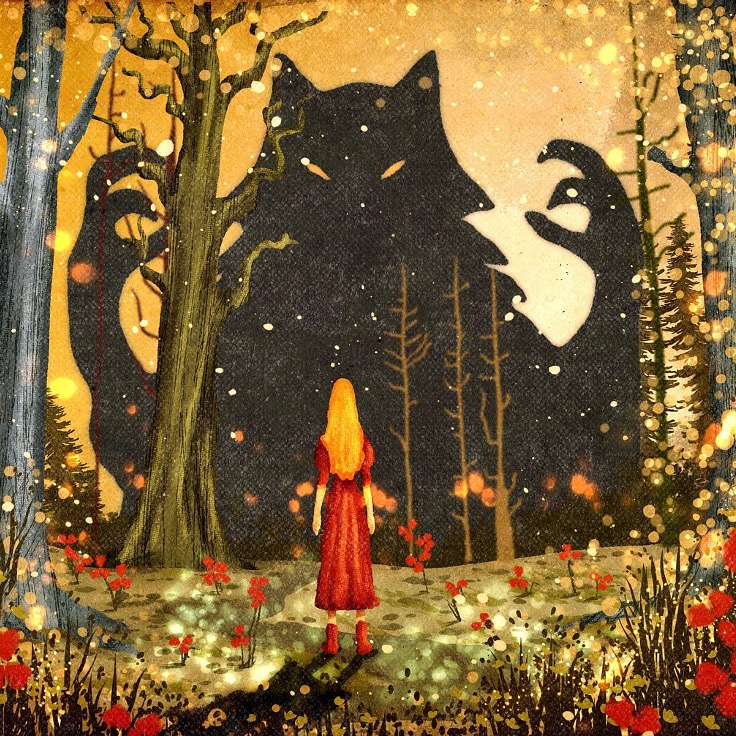
graphic by Peg Ihinger
“Villain” and “Antagonist” are frequently used as synonyms, because they fill roughly the same niche in a story. They aren’t quite the same thing, though. Villains are fundamentally evil; antagonists aren’t necessarily evil, or even bad. Stories always have some sort of antagonist, but that antagonist is not always a villain. To put it another way, villains are a subset of antagonists.
The dinosaurs in Michael Crichton’s Jurassic Park aren’t villains, but they are frightening antagonists. In most disaster novels, the primary antagonist is the tsunami, earthquake, shark, volcano, iceberg, tornado, or other natural phenomenon that is just…there, not evil. The usual stupid or face-saving bureaucrats who make the situation worse are usually not evil enough to rise to the level of villainy, either. They’re just minor human antagonists.
The situation gets murkier when you start looking at human antagonists. The demanding parents who want their son to go to med school instead of becoming a musician may be manipulative narcissists who don’t care about their child, only about the effect his choices will have on them. Or, they can be loving, worried parents who firmly believe that income and stability are more important to a happy life than self-actualization, and who are trying to pass the lesson on to their children in the only way they know how. The first are villains; the second, antagonists. They’re both obstacles in the hero/protagonist’s way, but one set doesn’t care about the kid’s happiness, while the other set cares deeply about it but disagrees with the protagonist about the best way to achieve it.
A lot of professional writers have said that villains are the most interesting characters to write. Villains, not antagonists. Yet when I look at a lot of the advice about how to write villains, the suggestions strike me as a checklist for creating a character that I would find totally boring to write about. (OK, I feel that way about most character checklists, not just the villain ones, but the principle remains applicable.) And a character who is boring to write about tends to be boring to read, especially if they spend much time on-stage.
The problem here is twofold: first, what makes for an interesting, memorable, hateable, scary villain varies from person to person. Some people like reading about the kind of cardboard cut-out “I am eeeeeevil! Because I just am!” villain who is in it for power or fame and who has no moral scruples or good qualities whatsoever. Other people want a complex villain with a more understandable motive, such as revenge, or one whose ultimate goal is reasonable, but whose methods are immoral and unjustifiable. It is practically impossible to satisfy both these readers at the same time.
Furthermore, the interesting, memorable, scary villain from one story will absolutely not work the same way in a different story. Switching Hannibal Lecter with the Wicked Witch of the West (both of whom are on Top Ten Villains lists) … well, you’d have to adjust both stories a lot to make it work, which would get you something interesting, but neither of the original plotlines would work at all well with the other story’s villain.
The second problem is that, in an effort to make their villains “truly evil,” some writers end up oversimplifying villains in stories that might be better off with someone more complex. It’s relatively easy to tick down a list of “evil” traits and qualities—evil laugh, check; kicks puppies, check; manipulates and corrupts others, check; fluffy white cat, check; casually murders minions when annoyed, check; overcomplicated evil plan, check. It’s even easier to pick an “evil” motivation off the apocryphal “villain motivation list;” hardly anybody in this situation bothers to look past the top four—power, fame, money, and revenge. (I tend to think of money as an equivalent to power in a villain’s lexicon, but I appear to be in a minority.)
While this kind of villain can be a lot of fun, especially if one is writing something intended to parallel or parody a cartoon series, they often suck the life out of a complex story, because they make the hero’s choice too easy. It is obvious that the villain is an unredeemable threat that must be taken down with prejudice in order to save the world. The hero doesn’t have to think twice about it, and neither does the reader. If you are writing a series, sometimes you can get away with a redemption arc for Darth Vader in the third movie, but it’s not an easy thing to do, especially if the author started off by making him appear to be a “truly evil” checklist villain in the first movie/book.
The villain character that I wish I had invented myself is the Mayor in Season 3 of Buffy the Vampire Slayer. He comes the closest, for me, to covering all the villain bases: he presents as cheerfully mundane, but he also checks off more than enough of the traditional “villain traits” list (evil actions, no scruples, complicated plans, manipulative, corrupting, wants power…) to be clearly and undeniably truly evil. It’s the mind-bending contrast between those two things that would make him fun to write (and that makes him, to me, one of the scariest and most memorable villains I’ve seen). I mean, his to-do list includes both “PTA meeting” and “Become Invulnerable”! (Not to mention the fact that he even has a to-do list and has been checking things off it.)


I like antagonists better because there’s always the possibility of redemption and the accompanying plot twist when they seek/receive it.
Out-and-out villains, though, are easier to write. And *sometimes* simpler is better for a story than complex. (And with disasters, simpler is the only possible choice…isn’t it?)
I tend to avoid villains when I want to keep the story light in tone. When I do deploy villains, I try to give them a twisted motivation: They don’t want the innocent to suffer; instead they have monstrous ideas about what counts as guilt.
“Of course I kick puppies! And exterminate them whenever I can! They’re the Whelps of Evil. Dogs are minions of the Dark One, sent from hell into this world to spread corruption and misery. And the Dark One laughs to see how far they have gotten in their mission. But I, I see their true foulness and will not compromise with it. Nor will I forgive those who give aid and succor to that evil.”
The advice that a villain is the hero of his own story is off base though. Some villains regard themselves as the heroes of their stories. Most, however, think of themselves in terms of being the smart guy surrounded by suckers. Even a dirt-poof thief who has spent more of his life in prison than out of it will laugh at the rubes who put in honest work and will never been rich. Moral reactions are reserved for their being the victim.
It’s true that the grifter type of personality you’re describing is depressingly common, but I don’t know that it fits most villains in interesting stories. It can certainly be done very well – many of John D MacDonald’s villains are like this, I think, and some of them are scary as all get-out even when they’re not remarkably competent. But larger-scale stories are a different thing. If a villain is of the Relentless Conquerer or Dread Tyrant or Transgressive Savant type, for instance, I should say that hero-of-own-story will usually be a better fit – however horrible, and even inane, their private story might actually be…
Nothing ruins a good villain like an after-the-fact backstory. Darth Vader and Maleficent are the two that leap immediately to mind. Maguire’s treatment of the Wicked Witch of the West didn’t bother me nearly so much because he rewove the entire tapestry, telling an entirely different story.
One of the first-readers of my WIS sent me guesses as to who the villain is when she was partway through. But I don’t think it has one. It has a number of very manipulative creatures who function, one way or another, as antagonists. I think Tyree is the striking one to me, as it genuinely loves the protagonist–in its fashion–and wants her to survive, but manipulation is the only tool it has. It would be dejected if you told it that it was the villain of the piece, but its intervention costs the protagonist her job, her freedom, and arguably her humanity.
Last week I was talking about my upcoming webcomic with some friends on Discord, and one of them said “Who will be the antagonist? You need a proper villain!” I wasn’t sure what to say at first, because it really isn’t the sort of story that requires a villain as such. Probably the closest thing it has to an antagonist is the MC’s estranged birth mother, with whom she has a complicated relationship.
I thought the BtVS Mayor was both really scary and extremely funny, for more or less the exact same reasons. I have a big soft spot for the sort of story which wants characters like that – both as a reader and a writer – but he’s very much adapted to his story’s particular tone. The choice of villains/ antagonists is going to have a lot of say in what kind of story one is telling, and vice versa, so I suppose it makes sense that coming up with useful generalizations about it is so difficult!
Personally I fall very much into the “Villany is boring and unpleasant” category for the most part, but that doesn’t mean I don’t like stories with villains, even “magnificent” villains, in them. It does mean that I don’t want to spend much time inside their heads, and that the amount and type of stage time they get needs to be watched closely. Classic case in point: I love Lord of the Rings, and admit it is a fair criticism that Sauron is more or less a faceless bogey throughout it. But we do – both from the book and from other material that became available later – have a sufficiently good idea of exactly what the Sauron of that period is like, and all I can say is that he’s earned his faceless bogeydom. More Sauron would distinctly not be an improvement: it would be a cup of cold sick. His secondary impact on people, places, and history is much more interesting and (from our point of view outside the fiction) almost certainly a good deal scarier.
Whereas the definitely antagonistic and unsympathetic Denethor of the book is not a villain, and needs his time onstage to come across as a tragic hero, whose pride and whose choices in hard places are bringing him to his personal and moral ruin. His cartoon villainization in the films really grated on me, and not because I like him!
Charlie Jane Anders is making some interesting related points on her Happy Dancing blog right now, in an entry about her being fed up with writing about horrible protagonists.
I was thinking about _Hellstrom’s Hive_, which made a big impression on me as a kid and surely is partly to blame for the WIS and WIP.
It has a strange structure. Except for one scene at the start which establishes the conflict (and the POV character doesn’t survive the scene), it’s in two points of view: the Hive leader and the secret agent who is trying to uncover what he’s doing. We start with the Hive leader and he’s pretty sympathetic, but the second half of the book is mainly the secret agent trying to escape the Hive, and being in such a bad situation makes him easy to identify with. They are clearly each others’ antagonists. I hadn’t seen that before (and I’m still struggling to come up with another example) and it made the ending shocking to me as a kid. (Trying to avoid spoilers, but you can see that with this structure, *someone* the readers are attached to is likely to come to a bad end. I guessed wrong on who it was.)
I’ve read Hellstrom’s Hive, many years ago, and for what it’s worth, I like the work of yours I read much more.
I can’t say that I remember Hive that well, just the shocking death you mentioned, and an overall memory that it just wasn’t very pleasant… (That’s a legitimate authorial choice, but it diminished my personal enjoyment.)