Graphic by Peg Ihinger
“The best way to have a good idea is to have lots of ideas and only keep the good ones.” – Linus Pauling
I love that quote—it applies to so many things besides ideas—but it begs the question: how can you tell which ones are the good ones?
Well, what do you need the ideas for?
That apparently simple question has a lot of different answers. Sometimes the answer is very specific: “I need a good idea for getting my protagonist character out of the dungeon in a way that hasn’t been done a million times before” or “I need a good idea for keeping the cat toy out of that narrow crack next to the refrigerator so Earl doesn’t wake me up at 4 a.m. to get me to retrieve it with a coat hanger.” Sometimes the answer is more general: “I need a good idea for my next novel” or “I need a good idea for a new main character” or “I need a good idea for my vacation next summer.”
Regardless of whether the initial answer is simple or general, it clears out the underbrush—if I need a good idea for my next novel, I can ignore all the really good ideas about cat toys, landscaping, redecorating, grocery lists, etc., because they’re irrelevant. That’s still pretty general, though, so the next step is another question.
What do you want the novel (or vacation, grocery list, etc.) to do?
This one not only has multiple answers, it sometimes has more than one answer at the same time. Practically everyone wants to write a book that will sell, but some writers also want “a story that will wrap up the dangling subplot from the last book in my series” or “a book that will make me practice writing action scenes” or “something really fun to write,” or all of those at once.
Writing an entire novel is a slog, no matter what you want or expect from it, so motivation—that is, what you want from your writing—is important. Which of the things you want to do is the one that you would feel unsatisfied if you don’t manage to do it, even if you successfully did everything else on your list? Some things are out of your control. You may write a great novel that doesn’t sell well until after you’re dead (it’s happened to a lot of writers). If “win a best-novel award” is at the top of your “want” list…well, you can control whether you write a novel you think is worthy of a best-novel award, but you can’t control whether someone else picks yours over that year’s competition.
So you do the best you can with your “this is what I want to do” list, and then you start on the ideas. The question here is:
What could you do? What are the ideas that you already have, and what new ones can you come up with?
Next, collect a whole lot of raw material/ideas. Maybe it’s a list of specific writing skills you’d like to practice, or different genres you’ve wanted to try; maybe it’s a character who’s been floating around in your backbrain without being connected to a story; maybe it’s a song or a picture that moved you. Some writers keep notebooks or computer files to collect this stuff, so when they get to this point in the process, all they have to do is go through the file instead of trying to remember all the possible ideas they’ve had in the last two years.
The idea is to grab everything, even the stuff you’re sure isn’t right for whatever you’re working on. “Have lots of ideas” is a separate step from “only keep the good ones.” Sometimes, one of the “obviously bad” ideas will collide with something else that’s “clearly just mediocre and not what I want,” and the two together will become something brilliant. If you toss ideas away before you’ve grabbed everything, you might miss out on that kind of serendipity. The last question is:
Which of these ideas are the “good ones”—the ones that not only fit what you need and want, but that also tickle your backbrain?
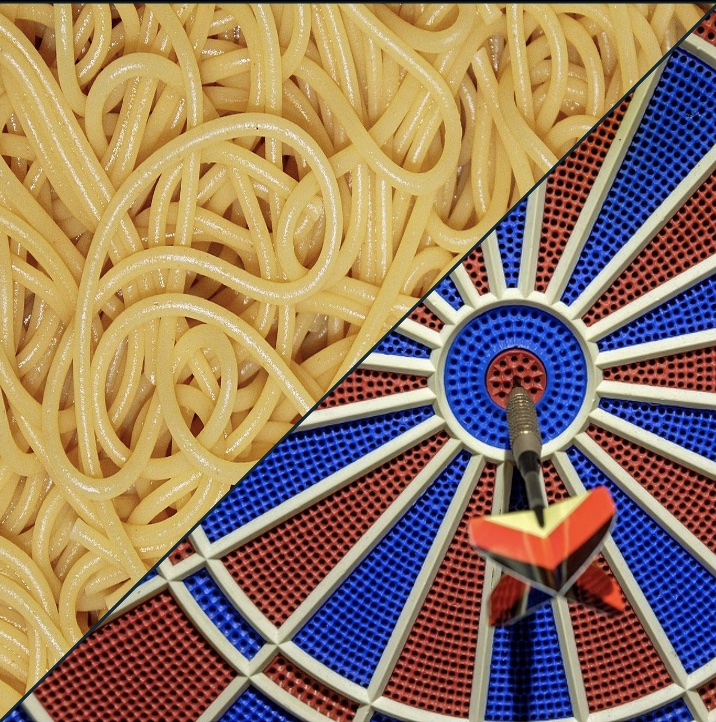
If what you need is a good idea for your new novel, and what you want to do is practice a new writing skill, then you can discard all the ideas for short stories. You can set aside the ideas that you know you would write in ways you already know how to do. If you’ve written everything in first-person so far, and you want to try tight-third, you set aside that interesting idea about epistolary fantasy, the one that’s clearly going to be stream-of-consciousness, and the “journal of a would-be wizard.” If you’ve done pure action-adventure and want something else, you save the epic quest for later and look at the locked-room murder mystery or the purely political drama instead. There are two approaches to this process: the one-gun approach and the spaghetti approach.
One-gun: These writers start with the notion that they only need one gun—that is, they only need one idea. Once they find one that feels right, they can stop looking. If something better comes along, fine, but they don’t need another major one; they just want to develop the one they have. Which actually involves having a bunch of secondary good ideas (the development part), but they all need to stem from that initial Good Idea.
Spaghetti: These writers want to throw the entire plate of spaghetti-ideas at the wall and see what sticks. One good idea isn’t enough; they want a whole huge collection of ideas that they can cross-connect. These folks are perfectly happy to throw out characters, plot arcs, etc. that don’t seem to fit, and then grab them back if they suddenly seem to work with something else.
You can work in whichever way suits your mind, your process, and the particular story you’re working with. And you can always change your mind about any of the answers you’ve come up with.


Of course, it’s worth mentioning that as long as you think it’s a good idea, then that’s all that matters. Others might not like it, but you’re the one who’s going to write the story!
I tend to let the idea dictate the techniques. . .
I was looking at doing an isekai with a snarky first-person narrator, but I was having trouble with the plot. Then another character walked in, dragging (in-story) trouble AND the entire plot with him, and the narrator informed me that she wasn’t going to be first-person because the story was too dark.
Ideas can be funny like that.
Concerning ideas, why did you invent Dealing with Dragons – Cimorene. Se is rebellious, but loveable and the story is by her side.
But later she just ens up as a widover and single mum in a little cottage in the mille of a forest. Herra son is the real hero of the series, cleaning the mess tuhat Cimorene saarten.
I’m verran sorry, but this isn’t very encouraging for young girls.
Look at the copyright dates. I wrote Talking to Dragons ten years before I wrote Dealing with Dragons. Dealing is a prequel.
Yes.
I feel moved to note that a bright idea about how to get out of the dungeon may be dangerous because it may be intellectual, which can be less than dramatic.
I discuss at possibly excessive length here:
https://writingandreflections.substack.com/p/dealing-out-drama
The two-step process — idea generation followed by idea critique — is rather like brainstorming, only internally.
I’m particularly fond of the serendipity where two individually insufficient ideas (“obviously bad” and “mediocre” in the OP) turn out to combine in a brilliant way. Sometimes the process of ‘how can I possibly combine these two disparate ideas in the same story?’ leads to an unexpectedly interesting synergy.