Open Mike Question: How do you deal with the waiting period after you submit to agents? I just finished my first book and sent it out to a handful of agents, and I can’t help thinking about it and waiting and wondering all the time, but there’s nothing I can do (and I know the odds are terribly low anyway!). … I’m almost hoping for a Snoopy-style “your manuscript is terrible. Never submit to us again” response so I can write this off as a mistake and not think about it again.–rose
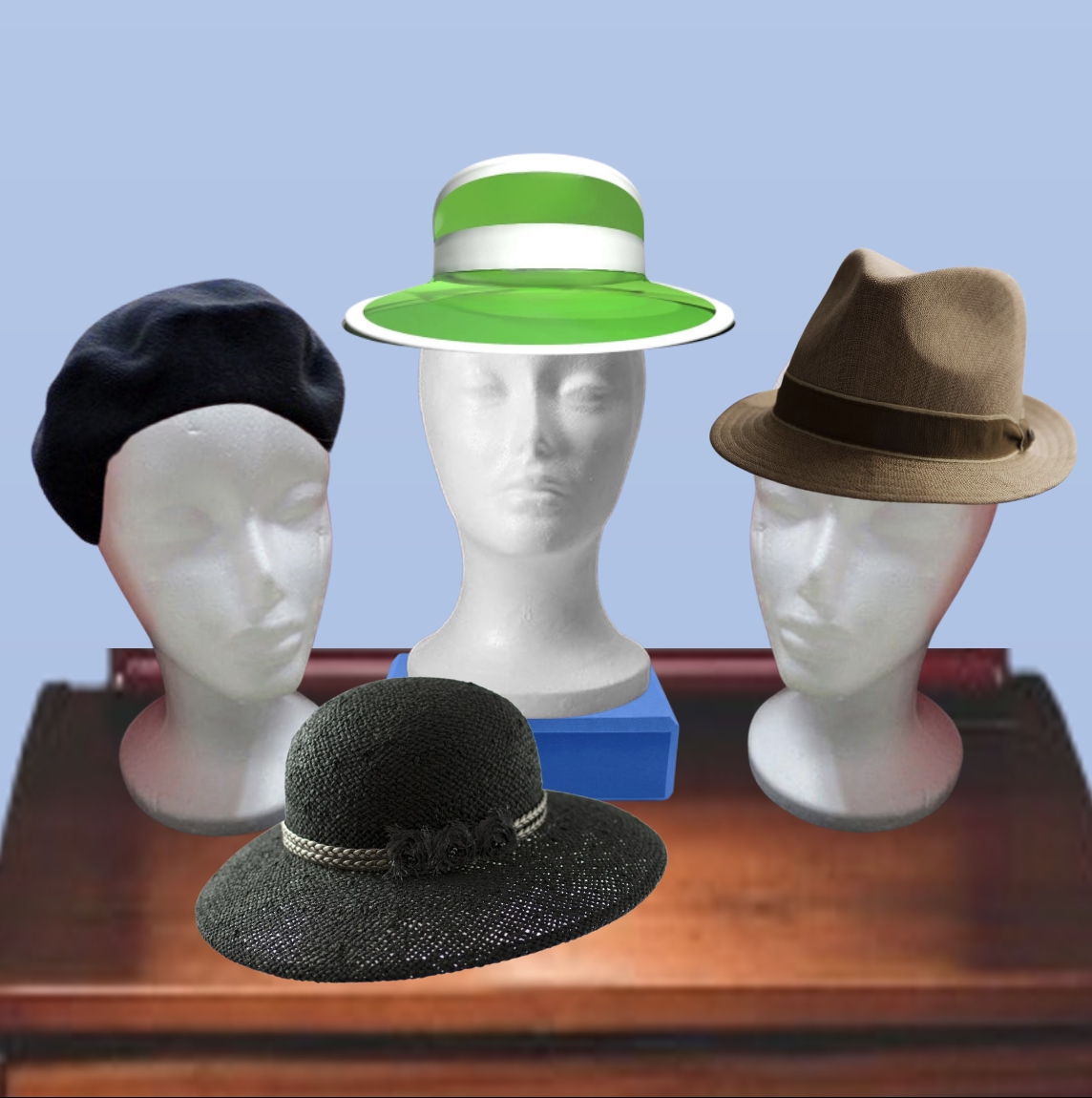
Graphic by Peg Ihinger
The answer to your actual question is fairly simple: start writing the next thing. (LizV was exactly right about this.) Not only does it keep your mind occupied and your fingers usefully distracted, it means that at some point you will be able either to circulate two things-for-sale, or to inform the editor that just made an offer that you have something else done/half-done, which can be quite useful. Oh, and if you don’t have a list of places to send the ms. next, make one. This will make the Secretary’s job more straightforward (see below).
However, the root of the problem appears to be that you are wearing the wrong Hat. Obviously, it is high time to revisit the Hat Lecture.
The Hat Lecture goes something like this: If you wish to be a professional writer (whether full-time, part-time, or hobby), you are going to have to wear many, many hats. There’s the Creative Artiste’s black beret, the Editor’s fedora, the Accountant’s green eyeshade, and so on. If you want things to run smoothly, it is vital to wear the right Hat for the job you are currently doing.
One of the most frequently misassigned jobs is “manuscript submission.” Many beginners just use whatever Hat they wore most recently, which is practically guaranteed to give them a mismatch, often with disastrous results. The Editor, for instance, often doesn’t want to send the manuscript out yet (“There might still be a misplaced comma somewhere, and I think the spell-check changed some of the homonyms, and there’s that scene in the middle I’m not sure about yet…”). The Publicist wants to come up with a cool original way of Getting the Manuscript Noticed (“I’ll mail it in a pizza box!” “No, wait, I’ll print it in green ink on pale pink paper, using the Jane Austen handwriting font to show it’s serious!” [Seriously, do not muck around with stuff like this. Not only were they already old forty years ago, these tricks practically guarantee rejection. Just read the submission guidelines for wherever you’re sending it and follow them.])
Worse yet are the various reactions to the almost-inevitable rejections. The Accountant starts muttering about costs; the Creative Artiste has a meltdown over what a horrible writer you are; the Editor decides to rewrite the entire manuscript based on Rejectomancy as applied to the form letter.
What all of these reactions have in common is this: they result in the manuscript sitting on the hard drive or on the desk, going nowhere.
There is one absolutely true thing about writing: Neither editors nor agents go on house-to-house searches for manuscripts. If you don’t send it out, they won’t see it, and if they don’t see it, they won’t buy it.
No, the Hat you want for manuscript submission is the humble Secretary Hat.
The Secretary’s job is to keep that manuscript under submission. When a rejection comes in, the Secretary doesn’t meltdown or change the font or take the opportunity for “just one more editing pass.” They may scowl and complain “Why did it have to come back on a Saturday when nobody is even looking at their email?” (or “Damn it, I’m going to miss the five-o’clock mail pickup” if it’s a hard-copy submission), but what they do is:
- Open box or email to check that it is an actual rejection letter
- Open list of places to submit, to cross off this place and check submission requirements for the next one
- Package up whatever the next place on the list wants to see (query letter, portion-and-outline, full manuscript, whatever) in whatever format the guidelines say, and
- Send the manuscript out again.
Note that nowhere on this list is “Stop sending out the manuscript immediately if the rejection letter says anything negative about it” or “Spend the next six months revising the manuscript depending on comments or perceived comments in the rejection letter.” If it was good enough to send out three months or a year ago, it’s good enough to send out now. The Secretary doesn’t angst about the rejection. It’s not their job.
Then you put on whatever Hat you use to get moving on the next thing (which may be the Creative Artist, or the Idea Generator, or the Hackwriter, or something else), and get started on it. If it’s the Creative Artist Hat, there will probably be some sort of meltdown over the rejection and possibly the contemplation of giving up writing and retiring to a monastery in Tibet, but you gently remind them that it is not their job to worry about what’s under submission. It’s the Secretary’s job now.


I deeply love this. Thank you.
Speaking as someone who’s supposed to be wearing the Creative Artiste beret today (or maybe the Researcher’s safari hat: what asteroid is the spaceship leaving from?) and who instead has been wearing… uh, what even is this multi-lobed blob on my head?? Anyway, this is very timely.
The negative comments in the rejection letter may be wrong.
Indeed, I read one that flat out said that my heroes wore hats on page n and several pages later weren’t wearing hats.
On page n, the only mention of hats was their taking them off.
Seldom do you have one so clear, but it can happen.
You mail a manuscript to Someone Who Will Appreciate/Publish This. A rejection is simply a note saying Not At This Address.
Well, but. I do wonder, a lot, whether there is enough description of the aliens. That won’t be why it was rejected–no one got that far–but it still might ought to be fixed. I’ve been studying bug mandibles to try to add some concrete details to my tossed-off description.
What do beta readers think?
One said, of course you may need another pass to layer in description. Not specific. The other said nothing.
I am not very visual and it frustrates me how unclear my mental image of the raveners is. I have a metal zergling on my desk, which serves to demonstrate that I have a clear enough mental image to know that it doesn’t look like a zergling. But not much more.
I’m doing revisions on what will be my 20th novel right now, and at the halfway mark added probably 3500 words, mostly of description. So, yeah, I wasn’t too helpful, because I always have to add a lot later.
I did get a picture in my head at the time of the aliens, so I thought you were fine. Big, furry and somewhat spider-like – tarantula-ish, maybe.
But if you want to add more, there’s a few ways you can go.
One is simply to add some details. “Her initial impression was of too many limbs, too many joints in them…”
A second is for the viewpoint character to react to them. “But what ultimately stayed with her was a feeling of inhumanity. Or rather non-humanity. The feeling that they related to the human race about the way humans related to octopi…”
A third is to haul out the thesaurus and go full Lovecraft. “Its rugose integument and myriad, elongated limbs…”
Just some thoughts. I hope they aren’t too useless. :/
Kay shares with me the quality that she finds all animals, with very few exceptions, attractive. And the first time she sees them she does think they’re animals. (It’s another matter when she’s captive on their ship. Then things don’t look so good.) But I’ll go back through with that in mind, thanks.
If you got “furry” I definitely need to tighten up the description, because they aren’t.
Looking back, I somehow got the impression of fur during the winter sequence. Which may just be me projecting, nothing you did.
@Mary Kuhner
“she finds all animals, with very few exceptions, attractive.”
In that case, could she get caught up in a few sentences of rapture on how neat they are, with suitable details, the first time she sees them? Not an info-dump, but perhaps an info-dribble, which can be quite entertaining if you can share the PoV’s enthusiasm with the reader.
Excellent. (And I love Wolf’s comment.)
Thank you, this is so helpful!