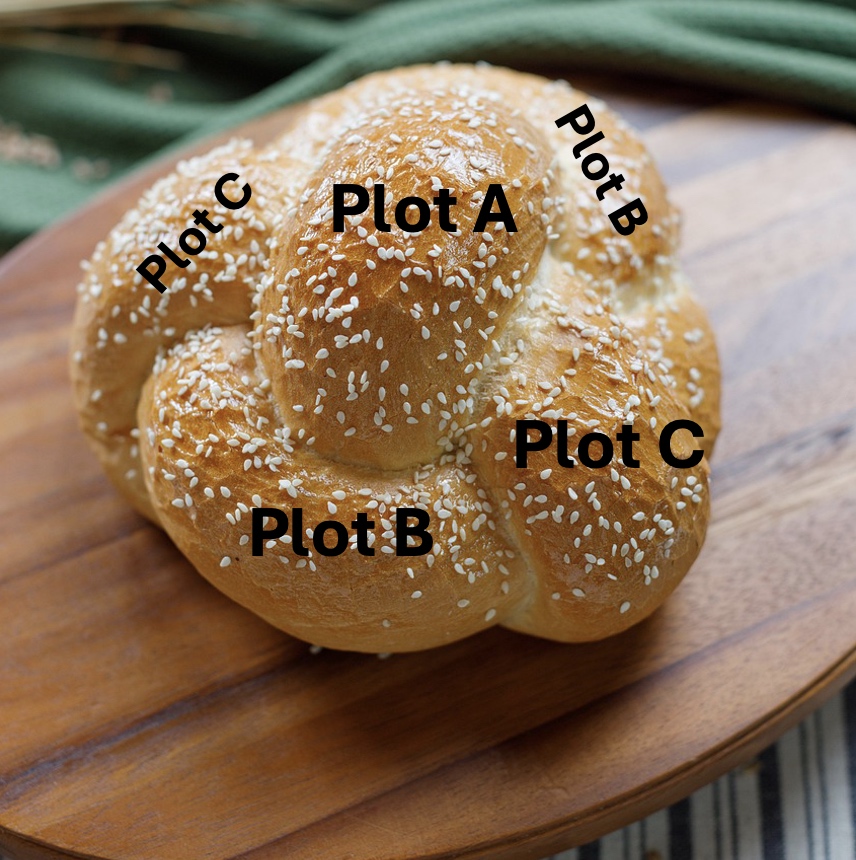
graphic by Peg Ihinger
Braided novels are a specific subset of multiple-viewpoint structure. In a braided novel, there are two or more protagonist characters who each have their own “A” plot-problem, which usually occur over the same time period and which come together in the same (or parallel) climax. The stories are “braided” together to make a longer one by rotating through the protagonists’ scenes, chapters, or sections until all of the plot-problems get solved at the same time.
Obviously, the more protagonists and plotlines there are, the longer and more complicated the braiding (and the novel) becomes. In most cases, two or three plotlines/protagonists are all that will fit in a novel, unless the author is deliberately writing a doorstop. Collaborations can be done this way, too–I’ve seen two- and three-author collaborations produced this way.
To be a braided story, you want each viewpoint character/storyline to be mechanically similar. Meaning, things like word count, timing of major plot points, and emotional impact are similar, and occur at more-or-less the same points in the overall story. This usually works better if each viewpoint character gets at most one or two chapters at a time (depending on the length of the chapters). If you give the first POV/plot eight chapters, it’s hard to switch to an independent second POV/plot and hold the reader’s interest…and by the time they’ve read eight more chapters of POV #2, there’s a good chance they’ll have forgotten what happened in POV #1’s plotline.
Also, switching between viewpoint characters generally happens at regular intervals in a braided story. A story in which the first half is from viewpoint A and the second half is viewpoint B is not a braided story. (I don’t know if there’s a term for this type of structure, but “braided” is definitely not it.)
If you give the first POV/plot eight chapters, it’s hard to switch to an independent second POV/plot and hold the reader’s interest…and by the time they’ve read eight more chapters of POV #2, there’s a good chance they’ll have forgotten what happened in POV #1’s plotline. You can get the same effect if you have too many plot/POV strands to braid…if the reader hasn’t seen George for five or six chapters, they’re not only likely to have trouble remembering what he was doing, they’re also likely to be more interested in what just happened to someone else.
Note that a braided novel doesn’t have to all take place in the same time period. One of the best examples of this I can think of is Peg Kerr’s The Wild Swans (https://www.amazon.com/Wild-Swans-Peg-Kerr/dp/0446673668) a fairy-tale retelling in which one strand of the braid takes place in 1689 and the other in 1981. Each involves a different protagonist in a completely different situation; what makes the braiding work are the thematic and emotional resonances tied to the original fairy tale.
Theoretically, it should be perfectly possible to write two or three independent stories that take place over the same time period and end at the same grand finale, and then go back and interlace them scene by scene, turning them into a braid. In practice, this is usually a lot more complex than it sounds.
The problem arises from the fact that one normally wants each of the viewpoint characters to be at the same point at the same time, both in terms of what day/time it is and in terms of what point the story is at. This means that if it takes two in-story days to set up George’s plotline, but only half an hour in-story to set up Sarah’s, Sarah’s story will need some way of catching up to George’s so that they stay in sync (or George’s story will need to speed up).
Keeping the stories in sync is especially important if there are major events that affect both storylines. If the dam gets blown up on Thursday in George’s story, but Sarah is still back on Monday, it means that the whole time Sarah is working her way through Tuesday and Wednesday the reader knows the disaster is coming and some, if not all, of Sarah’s efforts may be pointless.
Occasionally, the author wants the reader to know things in advance—if Sarah is a thoroughly unpleasant person, the reader can spend story-Tuesday and story-Wednesday gloating mentally over the fact that she’ll get her comeuppance on Thursday when the dam sabotage changes everything. Making this sort of thing work without destroying the tension in George’s plotline is hard, though.
This is the reason why all of the braided novels I’ve written (and most of the ones other people have written where I know anything about the process) are not written as two separate storylines that then get chopped up and interwoven. It’s hard enough to keep both the timing and the pacing in sync when one is writing everything in the order in which it is to be read. Trying to adjust either in an already-written story in order to make it match a different already-written story is even harder. Getting this wrong makes the whole story melt into a very lumpy multiple-viewpoint structure, rather than a nice, neat braid.
My personal experience is mostly with two-viewpoint “braids;” I’ve started two three-viewpoint braids, but haven’t managed to finish one yet. I wrote all of them “in order”—that is, in the order the scenes/chapters were going to be read. And the timing is always the thing I’ve had the most trouble with. The first two scenes or chapters are usually not a problem, but very quickly I realize that Rachel is about to spend a week traveling to get to the next plot point, while Seymour has at least three chapters of plot happening that week. So then either I have to figure out some things to happen during Rachel’s week of travel (which end up causing more trouble down the road), or else I have to find a reason why most of Seymour’s plot should wait for a week (which causes a different set of trouble down the road).


As a reader, when the stories aren’t closely related such that they need to be braided together I prefer the eight-chapters-at-a-time method. Every time a book switches between barely-related characters and plots it breaks immersion – so if they’re only going to come together at the end, then it’s better to tell them completely separately until the end, as in Diana Wynne Jones’s Deep Secret. I wish more books did that instead of alternating.
I agree with Rose – I prefer more time to get to know characters. Not necessarily eight chapters, but if it’s only going to be one chapter, it had better be a long one. I find a lot of modern epic fantasies jump too quickly between multiple POVs and then I’m moving on before I get invested in a character, and I end up feeling like I don’t care about any of them.
Similarly, I’m quite happy with an author deciding that Seymour has three chapters of plot while Rachel is traveling, and just doing three Seymour chapters back to back, then picking up with “Rachel arrived at her destination”. That’s usually better than sticking to an arbitrary rule about whose ‘turn’ it is to have a chapter and adding filler. If the author came up with cool stuff that happened while Rachel is traveling but which doesn’t actually fit in the main plot, write “Rachel arrived at her destination almost on time despite three pirate ships and an amorous giant squid,” and then consider the whole maritime adventure to be a separate short story.
It is quite easy to lose me as a reader by hooking me with a particular character and then switching away. This is at its worst when the character who hooked me is summarily killed (I can think of at least three books which did this) but it’s also bad if we just don’t see them again for a long time.
I am not sure I have ever fully appreciated the non-Frodo half of _The Two Towers_ because it is hard to drag me away from wondering what’s happening to Frodo.
Are there tricks for cuing the reader that this is the book’s structure, so it doesn’t come as an unwelcome surprise?
One where it did work for me is Glen Cook’s _Shadows Linger_, where there is a main story in the “present” intercut with big chunks of what’s supposedly someone’s journal (he takes some liberties with the form) in the past situation that set up the present conflict. The past situation is so immediately relevant to the present protagonist that it never feels like a digression. Pretty much from the start you know things will never end well for the past protagonist, but Cook made that work for me.
Later books in the series, though, he tries this again and this time it didn’t work for me. I was just frustrated with the alternate narrator and wanted him to shut up and let me get back to the main one.
Many years ago, on Patricia’s suggestion, I tried braiding the two timelines of a story that had really awkward timeline issues. I couldn’t make it work–it just felt arbitrary, not structural. Not a condemnation of the idea, of course, but for that particular novel I couldn’t do it (and doubt I could now, either).
And, of course, there’s no dividing line. In Even After there’s Biancabella, who’s clearly the heroine, and the characters who support her, but then there’s Constance, whose story brushes against hers at — three, maybe four points. And is less convoluted. And starts later. But this can blur with the subplot starting earlier, gaining more complications, and taking up more of the story time.
I’m another one who dislikes switching storylines back and forth — I usually spend half of each chapter resenting the switch, and get into the new story/viewpoint just in time to resent it when it switches back. There are cases when it’s worked for me — Cryptonomicon springs to mind — but they’re rare.
As a reader, I never mind the switch AWAY to a different storyline, but if you waited long enough that I’m confused about what’s happening when I switch back INTO a storyline, I’m gonna be very irate with the author.
I suspect a braided novel, even more than most stories, has to have strong dramatic unity to succeed. Multiple viewpoints or settings or time periods are fine. But if readers don’t perceive *one* problem/conflict, or one unifying theme, or one repeating character or image or something, then they may feel like they’re reading two separate stories that keep colliding, instead of one with separate elements combining.