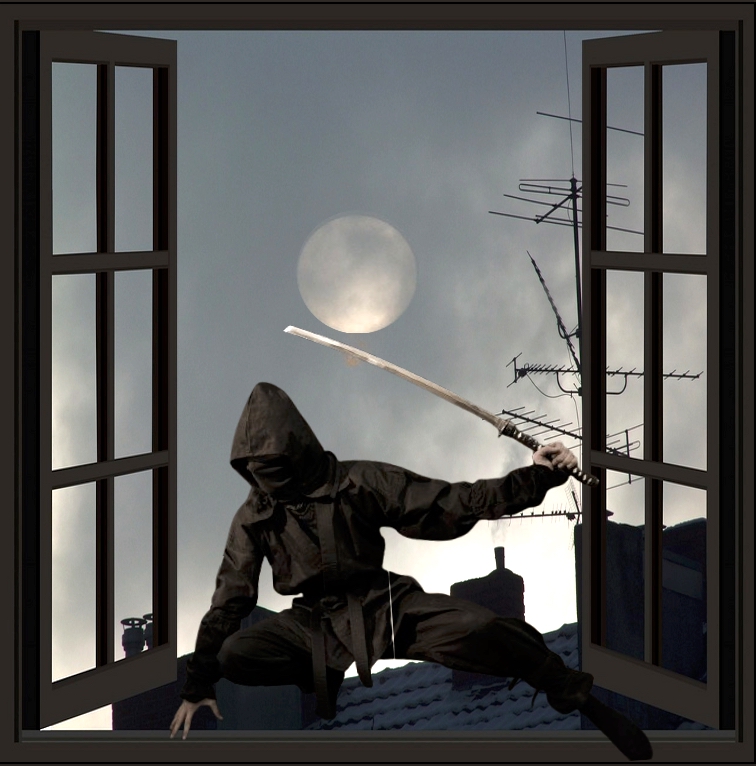
Graphic by Peg Ihinger
Years ago, “Have ninjas jump in through the window!” was the go-to suggestion for one of my then-crit-group members whenever a story’s pace slowed down, the writer was stuck, the characters were dithering about what to do next, the writer was dithering over which of six things should happen next, the plot seemed to be on life support, and half a dozen other things I don’t specifically recall.
While nobody ever actually put ninjas into their story (that I know of), the suggestion itself always uncovered something useful that needed work. The reason, I think, is that “Have ninjas jump in through the window” is shorthand for “This story needs shaking up.” And once you strip away the specific details, it implies a whole lot of possible ways to do the shaking.
First off, having anyone show up by jumping in through a window is likely to add a quick spike in drama. Even a mailman jumping in this way would be surprising, because windows are an awkward, highly unusual way of entering a room (especially if the window is on the second floor or above), so no one would expect it.
The unusual means of entry automatically raises all sorts of questions: Why is this person jumping through a window? Are they running from something, chasing something, or just a little crazy? Is the doorway blocked? Is there a fire or other emergency? Is everyone inside going to have to leave through the window, or just the person who came in that way? For some writers, these questions are enough to wake up their backbrain and get it moving again, which is part of the point.
Random ninjas are an even bigger wake-up call than a random mailman jumping through a window. Ninjas are not merely more surprising and more dramatic than a mailman; they also come with a reputation for being cool, competent, mysterious, and ambiguously threatening. Their sudden appearance is exciting, because they carry a suggestion of potential violence, and even more, of unknown forces moving in the background for as-yet-unrevealed reasons. The ninjas might be there to steal something, to assassinate someone, to kidnap someone, to rescue someone, and as readers, we can’t wait to find out what their reason is. Their mere presence adds even more questions about why they have come and what’s really going on, which the story will eventually have to address.
Once you finish filing off the specific details, what’s left is throwing in something unexpected, dramatic, exciting, mysterious, and/or suggestive that can shake up a bogged-down or stuck story by introducing new elements that require explanation (which will keep readers reading to find out what happens).
“Have ninjas jump in through the window” is a lot shorter, but that’s the effect it would have, and it’s the effect you want in this case. It’s a challenge to the writer’s backbrain: Throw in this weird, unexpected thing and then make it fit the story. Work out plausible background and reasons why it fits and what it’s been doing behind the scenes so far that have suddenly erupted into the foreground.
And that is why suggesting ninjas can actually be useful for writers. Pantsers do it to some degree all the time. Also, it’s perfectly possible to have a ninja moment that is sudden and unexpected for readers, but that the writer has planned for all along. In this case, the ninjas shake up the reader’s ideas about what is going on, but they don’t have any new effect on the writer’s backbrain because they’ve been built into the writer’s concept of the story since the beginning.
Surprise ninjas automatically shake up a story, and the harder they are to explain (why would ninjas jump through a window into the middle of Lady Ashford’s monthly tea party?), the bigger the impact. The catch, of course, is that the eventual explanation has to live up to the dramatic introduction of this (presumably) new plotline. Sooner or later, the ninjas have to be given a plausible in-story reason for jumping through the window just then, preferably one that ties to the existing plotlines and characters in an interesting and believable fashion.
It doesn’t have to be ninjas, of course. Having a previously unknown gentleman arrive in the middle of the tea party, claiming to be Lord Ashford’s illegitimate son might be more suited to the venue, the writer, and the story. Or the appearance of a lawyer announcing that Lady Ashford’s family has just lost their entire fortune. You want something that will shake the story up enough, which is a measure that varies by writer and story. Pirates sailing into the tea party might be worse than ninjas (since ships do not normally sail on land, much less into the sort of drawing room in which Lady Ashford’s tea party is most likely being held).
Ninja moments are not suited to all stories, even for pantsers, and such a dramatic surprise for readers is usually best done only once per story, unless you’re writing the kind of kitchen-sink plot that Voltaire did in Candide. And if you’re doing that sort of book, spacing out the kidnappings, shipwrecks, discoveries of diamond mines, pirates, and so on is usually advisable. Stringing too many ninja moments together end-to-end usually leads to something like Snoopy’s famous novel: “It was a dark and stormy night. Suddenly a shot rang out! The door slammed. The maid screamed. Suddenly, a pirate ship appeared on the horizon.”


If you’re writing on the basis of a theme, e.g. “Power over others leads to abuse of power over others,” then the ninjas need to reflect that in some way. Someone in power hired them to do something morally wrong? The ninjas are so power-mad they’re starting to invade tea parties? Anything that doesn’t fit the story you’re trying to tell is a candidate for cutting.
If you’re exploring a premise, such as “What if elves were hiding in the sewers of a modern city?” then the ninjas need to follow from that as well. Are they elf ninjas? Sewer ninjas? The elves’ secret enemies? Is there an old sewer tunnel under Lady Ashford’s stately home? It has to follow somehow.
In my early fiction efforts, I was all too capable of just introducing more and more barely connected elements to the story, trusting in my ability to somehow tie it all up eventually. (My success rate was about what you’d expect.) Which is to say, for some of us at least, ninjas through the windows can do what the story needs. But making sure they fit the story first *might* increase the success chances for the story.
Just my $.02, and worth every penny…
I’ll just have to figure out the nature of the conflict between the sewer elf ninjas and the septic tank dwarf samurai. Not to mention the gutter gnome guerillas…
I do realize you’re joking, but OMG yes please! 😉
My creative energies still haven’t recovered from my wife’s stroke last fall and then heart procedure just last month. (Some part of my mind is still running in circles and screaming.)
That said…I’m sure I’ll be back at some point, and I’ll try. I’ve done three novellas of whimsy before, I can do this.
Lady Miyoko sat in the tea room cross-legged on a tatami mat, contemplating the message that lay before her on the low table.
There was nothing wrong with that.
A tea service sat to one side on the table. An anonymous servant had served tea, and she had drunk of it.
There was nothing wrong with that either.
Lady Miyoko sat motionless and expressionless, thinking.
Which also was not a problem.
But she was human.
That was her first mistake.
What do you think? Right tone? Right track? Or do I need to get a little silly a little sooner?
I don’t know enough of what’s going on to say. But I’d read the next page!
The novel I’m currently shopping around starts with ninjas crashing through the window into the tea party — and come to think of it, also has (space) pirates, along with a great other many things. (All due credit to a previous post on this topic for the ninjas.) The whole book is basically things-jumping-in, but on a recent re-read I found it hung together surprisingly well. The rapid exploitation of belatedly-recognized opportunity….
Also, for the record, I really want to read the book about the sewer-elf ninjas.
I also want to read about the sewer-elves, with or without ninjas!
I am looking at the chapter I wrote recently, and am amused to see that the alien starship basically tells my protagonist and his human allies that *they* have to be ninjas jumping through someone else’s window (boarding a human ship by force). Which they are ill-prepared to do, so it shakes things up just as much.
I am troubled to discover, though, that I thought the alien starships were kept in the alliance by commitment to its goals, but having met this one–which is a right bastard–I don’t think that can be the case. Fleet command must have some kind of hold over them. My characters noticed this too: my protagonist said, “Isn’t that kind of a big thing not to know?” and he is right….
Could there be something about the alliance’s goals that coincides with/enables the starships’s goals? They’re not committed to the same cause, they’re just using these handy human tools?
For hundreds of years before the aliens knew there were humans, the progenetrix of the ship-colonies kept them more or less in line and pulling in the same direction. The progenetrix is not forthcoming about how she did (does) this. The daughter-ship colonies are even less so. It is apparently a Big Secret.
I like Big Secrets when I know what they are. I’m kind of worried about not knowing. They didn’t have FTL communication until just now. The daughter-ships would be out of contact for years at a time. They could not feasibly come to each others’ defense, so it wasn’t a mutual defense pact. Why haven’t they gone their own ways? I know why they keep the ship-technology a secret; that’s plain self-interest. But why will they come when she calls?
I actually got the daughter-ship to explain (not the alien colony living in it, but the ship-beast itself), and the resulting scene is very pretty, but my characters do not understand the explanation, and alas, neither do I.
Maybe it is saying that the ship-beasts have a kind of tenuous society, made of distant and fleeting contacts over the centuries; and while neither humans nor the crew-aliens can really grasp a society that functions that way, to the ship-beasts it is of paramount importance. And if you are living in a ship-beast you do not want to upset it too much: it might digest you.
This implies that progenetrix knows enough to use this social network to her own ends. She is full of secrets, that one.
It sounds like your ship-beasts are sort of harking to Moya from Farscape (never watched it, only vaguely aware of that entity). Live ship, part of alliance, but also kept in line and either exploited or ‘exploited’ by those who deal with them.
Christopher Paolini used self-aware ships as well, and each had their own agendas. Most had been ships so long they didn’t think about much else, and the reader is left to vaguely assume artificial intelligence for about half the book. One ship mind, however, revealed the terrifying truth. Every ship mind is transfer of consciousness from a human body to the ship brain in the dying moments of the human body. Volunteers only, as having someone unwilling in as situation like that can get- dicey. Its implied that usually ship-minds are men and women who wanted to serve and keep going, even as their bodies gave way. Most also seem distinctly alien these days.
The one on the page most often, though? He was willing, in that he didn’t want to die, and this wasn’t death. He’s also not entirely sane. Solitary confinement is a method of torture. And suffering a crash that kills all life on board, heavily damages the structure, and does not damage the mind-support framework? That’s basically solitary confinement. He’s loyal, and a friend, but always has this element of sinister danger at worst, and bewildering everything at best.
(also one of the best characters in the book. His triumphant return to himself with a shout of “Unhand that pig!” at the tentacle monster that was brandishing the ship mascot in a stasis tube was a great moment.) I mention this as a sample of how someone else did it, in the hopes it might jog some thoughts for you.
Oor, maybe the Ship-beasts have some terrible nefarious and downright evil nature, and plan on geological timescales, and every creature that lives on or in them is their unwitting pawn, their hands and feet in this vast plot.
Though, they probably aren’t immaterial demons inhabiting the physical framework of hardware built for them by an alien race long ago, interfacing with their denizens by psychic means while pretending to be computer driven, and harvesting the psionic energy of their unwitting pawns towards the end of destroying the galaxy. That’d be awfuly hard to set up.
“When in doubt, have a man come through a door with a gun in his hand.”
Then, Chandler was deriding the pulps. Whether it’s a gunman or a ninja, or whatever else fits in your story, you have to fit in elegantly.
In “The Firemaster And The Flames” my rule was “when in doubt, set something on fire.”