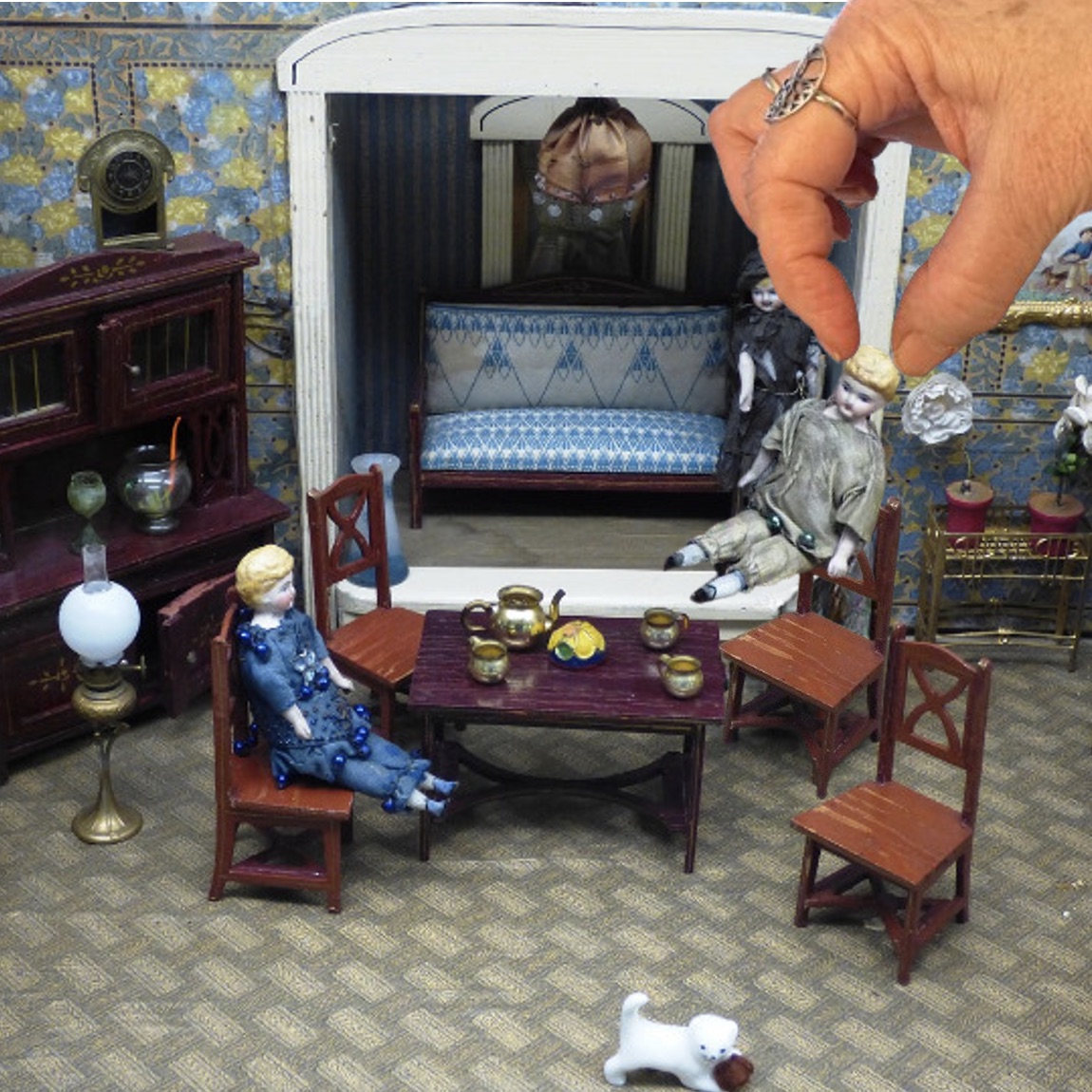
Graphic by Peg Ihinger
Today I want to talk about the “show” part of “show, don’t tell.” Because it isn’t quite as simple as it looks. (And that is why it took me the whole post to just talk about showing in terms of describing a setting, meaning I’m going to have to talk about showing personality and action in another post.)
On the surface, “showing” is simply a matter of giving the reader details, rather than generalizing about a character’s personality or usual behavior (they’re kind, stingy, timid, evil, wise) or the overall impression of a place (it’s creepy, inspiring, luxurious, desolate). As I mentioned last post, there times when generalizing is exactly what you want to do, but the fact remains that most of the time, most of a novel consists of scenes that are “shown.”
What makes showing a scene difficult are the choices: first, precisely which details to mention (or “show”), and second, how to most effectively phrase each one. For instance, from where I currently sit, I can see into my living room, which includes two windows (with different views of what’s outside), three lamps, two end tables, three chairs, a sofa, a love seat, a rug, a spinning wheel, a couple of bookshelves, and a cat tree. (Oh, and now there’s a grey cat picking a favorite sleeping spot.) Plus a bunch of clutter—cat toys, books, pictures, etc.—scattered around.
That bare-bones list of things I can see through the door into the living room doesn’t give you a picture, or even a good feel, for my living room (except for the cat, I think). It’s also not very interesting to read, because it’s basically just a list of objects. To really give you a sense of the living room, I’d have to tell you something about each of the objects—their size, quality, type, shape, color, age, and so on—as well as where each of them is in relation to everything else in the room.
Beyond things like color (the curtains are silver-gray), shape (the end tables are oval), size (the lamps are table lamps about two feet high), age and condition (the couch is over twenty years old, and the corners have been clawed by cats), and so on, there’s also the history of every item (one picture was a gift from a student; another was a gift from my sister; the end tables were inherited from a maternal aunt).
By the time I add all that to the bare-bones list, I’d be up to two or three pages of description, and wouldn’t even have gotten to the clutter. The same things are true when it comes to characterization and dialog: there’s far more going on in real life than will fit on a well-paced page. (I’m planning posts on dialog, characterization, and infodumps for the future, where I hope to go into this in more detail.
That is the technical side of “showing”—being able to describe the size, shape, age, history, color, and condition of the couch or the lamp or the cat; being able to provide a realistic transcript of actual dialog (including every digression, every “um” and “I know, right?” and every sentence that trails off into nothing); being able to give a blow-by-blow account of every punch, sword-stroke, dodge, or other move anyone makes during the big fight scene. This is the universe of details from which the writer can pick what to mention.
The art side of showing comes in choosing how many of those details, and which ones, to mention to the reader in order to get the effect the writer wants, in the least space possible. The important thing is the effect, not the list of details. Most writers I know don’t start by listing every object in their viewpoint character’s apartment. Instead, they decide what impression they want to give of the character, the apartment, etc., and then consider what sorts of details and presentation would give that impression.
“All the furniture in Bob’s apartment was second-hand” and “Every piece of furniture in Bob’s apartment was a valuable antique” can both be entirely true, but the phrasing gives the reader very different impressions of what the apartment is like (and, by extension, of what kind of person the owner of the apartment is like).
Showing a setting through the viewpoint character’s actions, reactions, and voice is often more effective than a flat description. A page of: “As he entered the living room, Daniel tripped on the fringe of the threadbare carpet. He grabbed the arm of the couch to keep from taking a header through the picture window. The fabric was damp and sticky. He pulled his hand back the moment he caught his balance, but couldn’t quite bring himself to wipe whatever-it-was off on his jeans.” is frequently more readable and engaging than a shorter static description like “The room held a threadbare carpet, a couple of chairs, and, just in front of the picture window, a couch with a sticky stain on one arm.”
Again, which method to use is a matter of art. Which fits the tone? Which keeps the story moving (or provides a moment for the reader to catch their breath or settle into a new place)? How important is the place, and/or Daniel’s reaction to it, to the rest of the story?
There isn’t a single, obvious right answer. The “best” thing for one story might be to cut everything down to “Daniel spent an hour searching Bob’s shabby apartment, but found nothing” while for another, a multi-page blow-by-blow description of the search and Daniel’s increasing frustration might be just what the writer needs to lay the groundwork for Daniel’s next move. What’s not “shown” can be just as important as what is.
There is no One True Way.


“I suppose the principal dilemma of the traditional or classic or straight deductive or logic and deduction novel of detection is that for any approach to perfection it demands a combination of qualities not found in the same mind. The coolheaded constructionist does not also come across with lively characters, sharp dialogue, a sense of pace, and an acute use of observed detail.”
– Raymond Chandler, “The Simple Art of Murder” (emphasis added)
Or rather, “Nobody gets everything for free.”
But one can choose to learn it, even if it doesn’t come naturally.
I had a scene where the protag manages to haul himself on a running horse. Initially, I described as succinctly as possible the actions he took to get into position, but my beta readers found it confusing and distracting. In the rewrite, I replaced it with “…from nowhere there was a rush, a sudden breath of heat, and Grayl’s arms wrenched as he was yanked off his feet. He was flying for a moment, weightless, then he was hit in the stomach hard enough for the world to go grey about him. Somehow he pulled himself forward and his feet found stirrups and his grasping hands released the saddle he had grabbed by instinct, and his fingers tangled in the mane of a madly running riderless horse.”
That “somehow” carries a lot of weight.
Le Guin has a rant about never using “somehow,” but I think it’s perfect when the POV character doesn’t quite know how it happened either, as in your excerpt.
“Somehow the gun was in her hand.”
Always remember your viewpoint when describing things.
If your viewpoint character can’t give the description you have to give, something has to change.
Not necessarily. In Lieutenant Hornblower, Bush is the viewpoint character, but the narration is in omniscient, and regularly comments on the shortcomings of Bush’s understanding. E.g. “A poet might have seen something dramatic and beautiful in those spider lines cleaving the air, but Bush merely saw a couple of ropes”
We were supposed to read, I think it was A Tale of Two Cities?, for a class in high school. I still remember the page-long description of a chest of drawers, because it was as far as I got in the book.