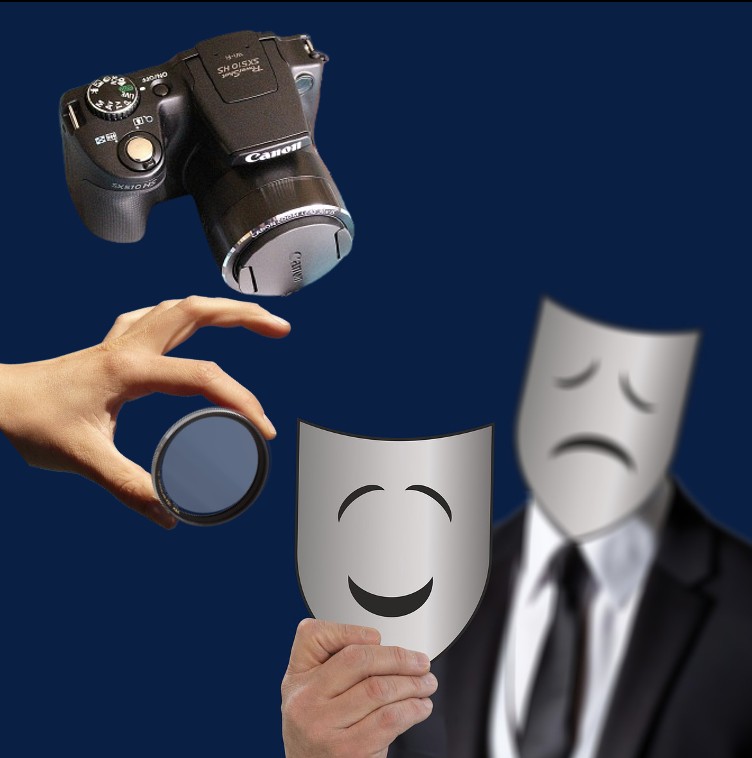
Graphic by Peg Ihinger
Characterization comes in two parts—physical and personality, or, if you prefer, external and internal. This complicates all the basic telling/showing decisions, which are complicated even more by what the story’s viewpoint is.
Let’s start with the physical/external, because it’s a lot like the description of places I talked about in the last post. Everybody has more or less the same set of physical characteristics: height, weight, hair, facial features, shape, and so on. Each characteristic has additional levels of possible description: five-foot-seven, lean, blond, grey-eyed, long-nosed, etc.
Any of these details can be striking, unusual, or missing. If they are, it’s usually a good idea to mention them specifically early on. Readers are likely to find it jarring if they’ve been reading about a character for several chapters, and only then find out that he’s missing a hand or she’s eight feet tall with naturally green hair.
The catch is the viewpoint. In first-person and the currently-most-common filtered tight third-person viewpoints, the narrator/viewpoint character is presumed to be describing things according to what they notice as familiar, unusual, or interesting. First-person adds the character’s opinions and biases to the mix. Other viewpoints, like camera-eye and omniscient, have different limits (though the writer will probably get criticism from those who think that third-person viewpoint only comes in the tightly filtered version, but that’s a discussion for the viewpoint post).
Personality/internal is a different matter. It’s arguably more important than what characters look like. The universe of potential details is a lot larger when one is showing a character’s personality than it is when simply describing appearances. People’s personalities come out in what they say, how they say it, how they act, what they like or don’t, their thoughts and emotions (and when and how they express them, or don’t), what things they fear or desire…pretty much everything the character says, does, feels, and thinks.
The problem is that, unless the story is written in omniscient viewpoint, the only thing the writer has to work with when it comes to non-viewpoint characters are the external expressions of the character’s personality. For a viewpoint character, the writer can express the character’s terror or wonder directly when he/she is watching a meteor shower. If the meteor-watching character is not the viewpoint character, then (absent telepathy) the viewpoint character can say for certain that the other person is looking up at the sky and meteors are falling. Anything else is the POV’s interpretation of the character’s body language or a guess based on how well they know the person.
And people—characters included—wear many masks for many reasons. We pretend to be happy when we’re not, to like ugly gift sweaters when we don’t, to have finished the job when it isn’t quite done yet. We pretend for social reasons and for personal ones, because we’re scared or don’t want to cause trouble for someone, because we were taught to, because we have something to hide for good reasons (or bad ones).
This adds yet another layer of complexity. How good is the narrator at seeing through other characters’ masks? What, exactly, made them decide that the girl staring up at the meteor shower was terrified, awed, or actually thinking about something else? How does the narrator know that the shiver they saw was fear, rather than just a cold breeze? And how can the reader know whether the narrator’s interpretations are the correct ones?
Showing what characters’ personalities are like depends a lot more on the art part of writing than on the technical parts. The viewpoint character’s opinions and assumptions can say as much about their own personality as they do about the characters they are observing. While this is generally a good thing, it does make choosing what to show and how to show it more complicated.
And choices are, once again, the difference between the technical side of showing and the artistic side. Much of the time, it’s an intuitive choice based on the combination of the narrator’s voice and things like how well the writer knows each character, how well the narrator knows each character, how much and what kinds of things the narrator routinely notices, and how much the writer wants to play around with what the narrator chooses to reveal to the reader at which times.
Writers can take deliberate advantage of the tension between objective reality as reported by the viewpoint character and the viewpoint character’s interpretation to create interesting unreliable narrators. They can also accidentally create a narrator the readers won’t trust because the narrator’s opinions and interpretations of other characters’ actions and dialog is significantly different from the readers’ opinions.
For instance, in middle-grade and young adult novels, some writers want the protagonist’s parents to be present and supportive of the protagonist’s adventures (rather than being obstacles or completely absent). It’s not a bad idea, but it can lead to situations in which a modern-day parent says to their twelve-year-old child, “Honey, watching you kill those six adult vampires was awesome! Thanks for saving us! Of course I’m okay with you going out alone at night until three in the morning to hunt more of them!”
Unfortunately, this leads many adult readers to think of the parent as irresponsible, careless, and possibly neglectful instead of supportive and caring the way the author intended. (Because an actual caring and supportive modern parent would more likely say, “What were you thinking, running straight at six full-grown vampires like that? You’re twelve. Okay, the way you defeated them was awesome, but you’re still grounded until you’re thirty. And bedtime is still nine o’clock, and I’m going to be checking.”)


It’s even more fun with characters who, whether unreliable narrators or actors or whatever, keep pretending to be other people. 🙂
Even with telepathy…. I report what Ryan perceives Nithya to be thinking and feeling, but with the double caveat that she’s an alien who he doesn’t fully understand, and that she can in fact mindlie. (He can’t; one of several problematic things about their relationship.)
There are a couple of scenes formally written from Nithya’s POV, but I don’t think they are really: I think they are Ryan vividly reliving Nithya’s memories. *Two* levels of possibly unreliable narrator there. I don’t think I’ve thought enough about the status of those scenes, actually. It’s kind of a weird thing to do.
(When I set out to write this, it was “obviously” going to be alternating chapters from Ryan’s and Nithya’s POVs. But I just kept writing Ryan-POV scenes until it was clear this was not going to be the case. I don’t know why the initial idea didn’t work, but it didn’t.)
Telepathy with aliens is advanced stuff, for exactly the reason you mention (two levels of what’s-really-going-on). The advantage is that the writer can show the telepathic viewpoint character being unable to comprehend things they see/hear in the alien’s mind. Something like synesthesia might be a useful way to approach it–the telepath can be absolutely clear that the alien thinks the bench looks like a C minor chord, without having a clue as to what that actually means.
I spend a fair number of words trying to express one of the alien characters’ way of making (maybe?) a joke, which is to mind-say something but wrap it around a negative space which says something else. They ask it if it lost a particular conflict because it was enjoying the fight too much: it says “that was a very serious fight for my colony’s survival” and wraps it around “yes.”
The main character manages to irk it once and it says nothing at all, wrapped around a negative space of “you are an idiot.” Which makes no sense to him–how can you communicate anything by saying nothing?–and he is left thinking that as a telepath he barely manages baby talk and is unlikely ever to get past that.
Also trying to work on what happens when you get direct sensory input from something that has senses you do not: particularly, some untrained people get a full-blast “this is what it looks like” from the sentient Jumpship, looking out into deep space with vision that covers the entire spectrum from cosmic rays through radio, and a lot of spectroscopy on the results. So I talk about sounds, and flavors, and tactile sensations, and how those are all inaccurate. (It causes something of a riot, and no wonder.)
I was maybe overimpressed by _A Voyage to Arcturus_ and its two extra colors in the spectrum, when I was quite young. Can’t quite do it but it’s fun to try!
FWIW, I love that joke!
I’m working on a story where I thought I could write it as a snarky first-person viewpoint. Only it took a turn for the darker, and the narrator grew more heroic, and the snark was too much, and also the first-person came across as vain.
Had to rewrite the opening. Hard.
Juggling parents in a children’s tale is always interesting.
Buffy’s mom: “Have you tried just not being a Slayer?”
In terms of physical appearance, there is also how to handle racial descriptions (or ‘complexion’ if that is how it is processed in the setting), how to handle non-human descriptions, and how to handle non-human racial descriptions.
And something that IMHO gets too little time in how-to-write discussions: How to describe the clothing a character is wearing.
Aye. There is one sequence in my WIP where what the protag is clothed in is important—but that is the only time that is important. But because those scenes exist, I now have to give a modicum of description to *all* the clothing throughout the story.
I struggle describing my characters. Or describing anything…
Describing their looks, or describing their personality? If you’re the sort of writer who does all the dialog and action in a white-hot creative heat, and then realize that you have a bunch of talking heads in a white mist, you can layer in everything else on the second draft. If you just don’t know or care what they look like, you can still do it in the second draft, but you’ll probably have to think about it more deliberately.
Describing luokse. Once Iwtote that one villain had golden hair. When People complain and to Write More I can describe More.
If you can describe more once someone asks, then it isn’t a matter of not being able to describe a character’s looks. It’s a matter of remembering to do it (or possibly you don’t really like describing people, so you avoid doing it until someone insists on it). Once you figure out why, you can decide whether it’s something you want to add to your writing (there are quite a few writers whose description of characters is limited to height and hair and eye color) and, if so, when and how you want to add it.
I think that Cimorene should have listened her parents…
And married the idiot prince? She’d have had a miserable life.
The things they insisted she learn — like etiquette — did indeed turn out to be useful for her, but so did the things they didn’t want her to learn because they weren’t proper for a princess, like cooking and Latin.
Sadlyshe started a chain of events that Rainer her, Mendarbars and Daystars lives and put the kingdom in chaos for almosttwenty years
How do you figure that? It was the wizards who stole the sword and caused all the chaos, and they would have done that whether Cimorene was married to Mendanbar or not, because they wanted power over the forest.
I,m sorry, but you wrote about parents…
Have I offended you?:(
Not at all.
Thank you
Mary Catelli’s post brings up something I’ve been pondering. The big problem in a children’s adventure story is how to get the parents out of the way, so that the children can have an adventure at all. (The OP’s second option as preventing the first — “rather than [a] being obstacles or [b] completely absent.”) You can take the children somewhere the parents aren’t — the Narnian stories, for example. You can have the parents out of town (“Home Alone”), or captured by the bad guys (wasn’t that in “Spy Kids”?). Or the kids can stow away into danger (“The Incredibles”). There are a lot of options, but after seeing a dozen or so of those stories with parents conveniently absent or plausibly resisting the kids’ involvement, I can see how one might want to try to make the parents present and supportive — with the kinds of problems noted in the OP.
Or go a little on the horror side:
She ran. She ran as as fast as her short legs would let her.
And as she ran, her father’s words kept ringing in her ears.
“Go, baby! Run! Don’t worry about me. I’ll be fine. Now run! RUN!!”
But the troll’s/ur-spider’s/Cthulhian monstrosities’ limbs were already encircling him…
I must be a ‘lumper.’ This looks to me like a variant of “The child-protagonist is an orphan.”
I’m not typing this out again:
https://writingandreflections.substack.com/p/the-adult-problem