Graphic by Peg Ihinger
Creativity is not a well-understood thing. Most people have no trouble recognizing its results, but they have a lot more trouble recognizing creativity in process…sometimes, even when it’s their own.
People keep trying to break down the creative process into neat little boxes, in an attempt to come up with a recipe that other people can follow: “Preparation, Incubation, Illumination, Verification,” “Preparation, Investigation, Transformation, Incubation, Illumination, Verification, Implementation,” “Identify, Engage, Brainstorm, Prepare, Reflect, Seek insights, Design the solution, Finalize and test.” The only one I could find that actually struck a chord with me was Arthur Koestler, who pointed out that creativity has three pillars: the Bed, the Bath, and the Bus (because those are the places where a lot of creative breakthroughs happen. Which is more of a description than a recipe).
The biggest problem I see here is that people are trying to come up with a universal recipe for dinner, even though a realistic recipe has to take into consideration what tools and ingredients you have, as well as who you’re cooking for, whether it’s a special occasion, what you feel like making…and, of course, that “dinner” can range from a one-pot casserole to a seven-course meal plus dessert.
Any recipe or formula that covers all of that is going to be so general as to be useless when it comes to making an actual meal, let alone a specific one. You need different tools, from heat source to special pots and pans, depending on whether you’re making homemade ice cream, grilling a steak, or cooking a souffle. These tools are pretty easy to recognize when you’re tallking about cooking and you’re looking for a pot large enough for that big chili recipe, but they’re not as obvious when you’re writing a novel and the key bits are all mental.
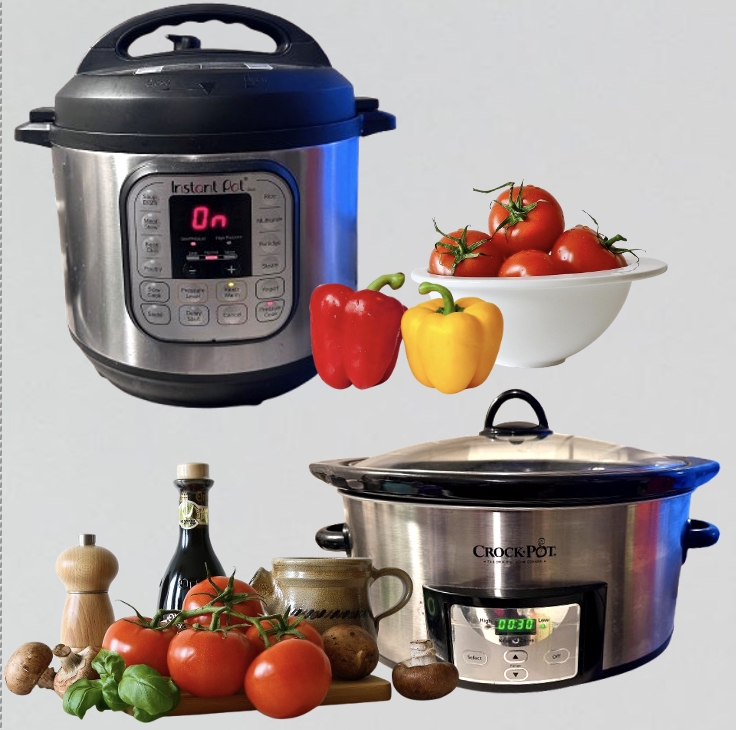
In particular, there’s a big difference between crockpot creativity and pressure-cooker creativity.
Pressure-cooker creativity often involves a serious deadline. It doesn’t matter whether it’s the publisher, the editor, the agent, or the writer who has imposed the deadline. It only matters that the writer is taking the deadline absolutely seriously. It’s the writerly equivalent of cramming the night before the exam, or pulling three all-nighters in a row to finish that paper. It produces fast results out of necessity–that deadline is immovable.
Pressure-cookers require a relief valve. And if the valve clogs, the pressure builds up until it explodes and blows everything all over the ceiling. Also, there are some things you cannot make in a pressure-cooker (croissants come to mind). Pressure-cooker creativity has similar downsides, though the eventual explosion is usually emotional or mental, rather than physical. I think of it as more of an emergency last-ditch effort, rather than as something to depend on routinely, but I’m a plodder. Burst writers and pantsers get a lot more mileage out of pressure-cooker creativity than I ever would.
At the other end of the spectrum is crock-pot creativity. It takes a while–sometimes quite a long while–and while it can sometimes benefit from an occasional stir, it usually doesn’t need careful watching. That’s the whole point of a crock-pot: you put in a bunch of ingredients, turn it on, and walk away for six or eight hours. When you finally come back, there’s soup or stew or pot roast, ready to eat. Crockpot creativity isn’t high-pressure, high-heat production. It takes months or years for some projects. The thing you don’t want to do here is forget about it completely, so that everything simmers down to an inedible, unusable dry crust that takes forever to chip off. And again, there are things you can’t make in a crock-pot. Many of them are the same things you can’t make in a pressure-cooker (angel food cake, fried chicken, cookies…).
Both crockpot creativity and pressure-cooker creativity are about the making things up part of writing. For me, pressure-cooker creativity works best when that’s the only thing I need to do, because I have already done everything else. If I need to do a bunch of research on a particular place or time (or do a lot of worldbuilding, if it’s a completely imaginary place/time), it’s not going to be a pressure-cooker situation.
Because wiith a pressure-cooker, if you forgot to put something in at the start, you have to depressurize it carefully before you can even take the lid off to add it. Crockpots are easier to throw something in while everything is in-process. Whatever you throw in still has to fit with whatever is already in there, or you’re liable to end up with something inedible (like trying to make boxed macaroni and cheese with strawberry yogurt because hey, it’s a dairy product, isn’t it?).
If the project has a lot to do that isn’t making up new stuff, trying to push (pressure cook) the creativity probably won’t work very well. It may actually slow things down, because I’ll make up an incident or a character, and then two months later my research will reveal that that incident or kind of person simply couldn’t happen in the time/place/situation I invented. Which leads to lots of throwing things out and starting over.
Most writers I know use both kinds of creativity at different times, but lean strongly toward one or the other. The real trouble comes because I don’t know any writers at all who don’t want a faster, easier process than whatever they have. And pressure-cooker creativity is fast, and it demonstrably works for some writers.
So people set themselves impossible deadlines, or sign contracts with unrealistic delivery dates, hoping or expecting that doing so will trigger pressure-cooker creativity. And for some of them, it will work…because they have the discipline, focus, and energy to stick to a self-set deadline, project after project, and because they’re writing the kind of thing that works well with pressure-cooker creativity. People who don’t work that way, and/or aren’t working on a project that’s suited for pressure-cooker creativity, generally don’t get the same results, though they often feel as if they ought to. This can be extremely discouraging.
Ultimately, the goal is to finish stuff, not to do things the “right” way, the “fast” way, or even a “better” way. Because There Is No One True Way.


And sometimes even if the pressure cooker works for you, you don’t recommend it. I once wrote 11k words in one morning. I deeply highly do not recommend the stress.
I dunno.
As a kid, I made up all the games we played. When I got a Lego set, I never tried to build what was on the cover, I’d always see if I could come up with something else.
In high school, I wrote a play – a parody of Star Trek. (It was terrible.) In the military, I created all these working aids. I didn’t stop there. I’ve never stopped.
Creativity is like my heartbeat – or, more aptly, my subconscious. It’s always there, it’s a force, a power. If I go for very long not coming up with something, I can feel the pressure build in my mind. I have to create something new. I always have. I still do, in old age.
This entry for me isn’t about creativity, it’s about the process(es) of expressing it.
Lego sets are bad. Kids should get free-form Legos.
This, yes. I am old enough to remember being horrified when the first Lego “kits” came out, with detailed instructions on how to make the thing in the box picture. Defeats the whole point of Legos!
There’s also something so basic I’ve never seen it written as advice anywhere, which is that creativity can build up slowly. Maybe you write one sentence that appeals to you, with no idea where it’s going, and then a few weeks later you read something about forests and think “hey, maybe that sentence happens in a forest…” and then a few weeks later you think, “why aren’t there more retellings of Hansel and Gretel? maybe that would be a good plot for The Sentence.” And then you write a little more, and plot a little more, and worldbuild a little more, and it all snowballs… the more things you have to jump off of and wonder about, the faster the creativity happens. But the beginning can be very, very slow.
That’s part of why I didn’t write much for many years – I didn’t “know what to write about,” I thought real writers started with a fully formed story in their heads. Then I realized you can just *start* and wrote a novella with no idea where it was going. You don’t have to have much of an idea to begin; you can start with one or two cool things and just let more things happen until you reach a critical mass. And I don’t think this is just true for pantsers, worldbuilding my new thing has been the same way – I started with one line in the notes document, and it slowly grew, and the longer it got the faster it grew.
Anyway… this is just a long way to say, the beginning of the process can be very, very slow. Which probably everyone knows already! But I didn’t.
One day I was going through old folders and found a page of dialog. It obviously had to do with an old roleplaying setting, but it had its own characters. And it was kind of intriguing. I wondered if I could write any more of it.
Four months later I had a finished novel, which is by *far* a personal record.
I think that page of dialog had sat there for a decade, minimum. I don’t know why it suddenly turned into a novel. It did help that I knew the setting, so I didn’t have to invent as much of that.
It was pantzered all the way, as you’d expect. In particular, the Emperor had four children, and I’d established that trying to become a dark magician destroys a third of those who try (“dead, mad, or a monster”). To demonstrate that I ended up killing off the least developed of the four. And then the Emperor raised her from the dead and told my protagonist he better deal with “mad and a monster”, or else.
She is the protagonist of Part III. I did get to know her eventually, though initially only as a mad monster….
I am not sure, incidentally, that pressure cooker style is more useful to pantzers. I have never succeeded with NaNoWriMo in multiple attempts, because if I keep writing past the point where I really need to know something, I am probably doomed. But working to a deadline pressures me to do exactly that.
Book 1 of the current thing did not need to know Earth’s future history in much detail. Book 2 *does* and I have to tackle that. If I don’t, I am going to get badly stuck, or write something with problems I can’t fix.
I have 8K words of something I can’t fix in a file somewhere. I just started writing without backstory. The worldbuilding is okay, the situation has promise…but there is no backstory that makes the protagonist make sense. She does not behave like she’s here under coercion, but she really does not seem to be someone who would have gotten into this bizarre situation by choice. It’s fundamentally incoherent and completely pervasive.
And here I would’ve said that planners get more mileage out of pressure-cooker creativity — they’re the ones that know where the thing’s going, after all, so it’s just a matter of sitting down and writing it, right?
(“Just”, I know. If only any method really worked that way….)
I have found the pressure-cooker of NaNo or thirty30K.com very useful — in the right years, for the right books. Most of the time, though, it’s semi-steady plodding that gets me where I want to be; the challenges work best as a jump-start, to remind me of how much I can do if I really put my mind to it.
Speaking of which: I have finished the WIP! For values of “finished” that include find-a-better-word brackets, of course, and a couple small chunks that I can’t decide whether I need or not, and whatever else turns up when the alpha-reader and I both give it a full read-through. But it is a coherent slab of text (135K!) with a beginning and an end and no gaps in between. Hooray!
Hooray! However much work there may remain, it’s super nice to see the whole thing and be confident that there *is* a whole thing.
Congrats!
(resubbing as reply, since it lost its parent)
O frabjous day!
Congrats!
I use a mix of both. Sometimes, I’ll get an idea and knock out 20-30 thousand words in a weekend. Most of the time, I plod along quietly, adding a bit to various stories here and there as the ideas find their way in.
The pressure cooker weekends are what I prefer–it feels very productive to sit down and write for eight hours a day three days in a row. But I also don’t have the energy to do that more than once every few months.