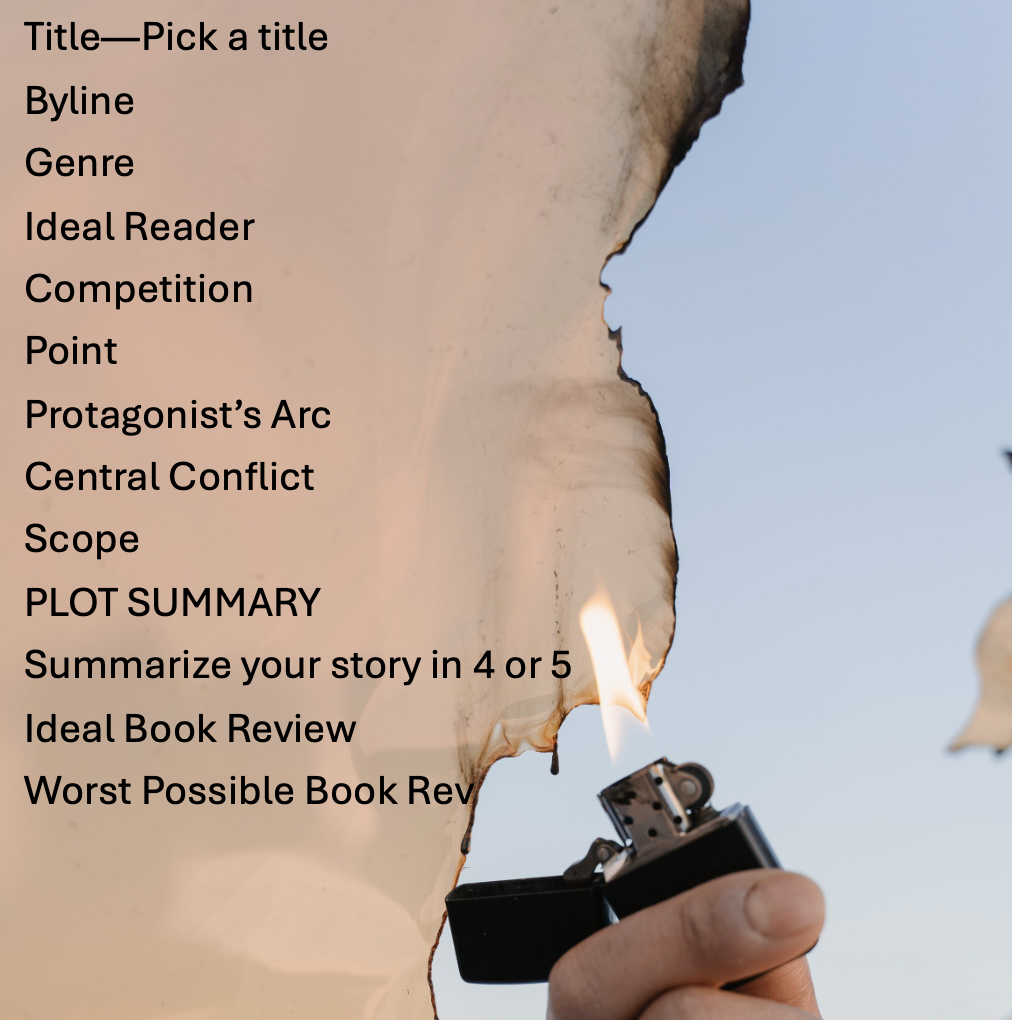
Graphic by Peg Ihinger
I ran across a place the other day that had a free “how to prepare for writing your novel” worksheet. Since I’m starting a new novel and I’m always curious about this stuff, I downloaded it on a whim. The worksheet turns out to be a list of “key things you need to know before you start writing,” and it all fits on one page, which made me wary right from the start.
The first thing on the list is “Title—Pick a title.” I blink and then shrug. You do want to have something to call the thing you’re working on, but it’s not the first thing I worry about. It’s not even the second thing. I’m frequently on Chapter Three of “The [Protagonist’s Name] Book” before I come up with a working title that actually sounds like a title, and in the end my editors have changed it at least four times that I can think of off the top of my head. Still Talking to Dragons started with the title, so it does happen. It just doesn’t happen to me very often.
The next line is “Byline.” I am about to go on a rant about pen names, when I see the description: “Claim your story! Assert your authority over your work!” I think, What? I mean, if my story isn’t going the way I want it to, having “BY: ME” at the top of the page doesn’t change that at all. Also, a byline is not something I have ever needed to think about in order to write something, not even back when I was debating about whether to use my maiden name or my married one on my first novel. It didn’t even come up until after the editorial revisions.
Next comes “Genre” with a list of places to look for suggestions if you don’t know what genre you want to write. I shrug. This also isn’t anywhere near the top of my personal “List of things to think about before starting a story.” Either the genre is obvious from the story idea, or I write the story and then figure out the genre.
By this time, my expectations of this “how to start your novel” list have dropped significantly. And then I get to “Ideal Reader.” This is not just something I don’t feel any need to think about. It is something I actively refuse to think about if I can possibly help it. When I’m writing or preparing to write, I need to think about the story, not who might read or like it. Honestly, I don’t even think about it when I’m doing the final round of polishing.
I start skimming. After “Ideal Reader” comes “Competition” (make a list of the top books in your chosen genre. Just list them; there’s nothing about actually reading them, which would actually be helpful if you are planning on writing a random genre you know nothing about) and “Point” (what your message is…ugh) and then, finally something possibly useful: “Protagonist’s Arc.”
Wait, “Protagonist’s Arc”? But there isn’t a protagonist yet. There isn’t even a story or a situation. I look at the description. Apparently, I’m supposed to decide what my protagonist wants and how the story will change him/her/it/them before I know anything about who he/she/it/they are, where and when he/she/it/they live, or, well, anything about him/her/it/them except for their existence. I suppose that’s possible, but deciding that my protagonist is “Someone Who Wants To Graduate From High School Next Week” is not very helpful to me. Everybody who has made it to the week before graduation from high school is eager to get out of there next week, but they are definitely not all going to have the same character arcs.
Next comes “Central Conflict.” That, too, might be useful, if my protagonist actually felt like a person and not a faceless Someone Who Wants To Graduate From High School Next Week. Though this getting-started worksheet still expects me to figure out what is keeping Protagonist from getting what she/he/it/they wants (it suggests “their boss” for an external obstacle and “fear” as an internal one, neither of which seems to apply to Someone Who Wants To Graduate From High School Next Week).
“Scope” comes next, which apparently means how much time the story is going to cover. I still don’t know what the story is; how should I know whether it covers the next two weeks of the character’s life, the next four years they spend in college/trade school/first job, or their entire biography until they die at 85? I suppose I could set up a target and throw darts at it…
Oh, finally we get to something recognizably useful: “PLOT SUMMARY.” In all caps and bold face, which is appropriate because this is important. And…Oh, dear. “Summarize your entire story in four or five sentences.” That’s not a plot summary, that’s an elevator pitch. Yes, boiling a novel down into a short paragraph is a useful skill, and there are definitely writers who start with a single paragraph and blow it up into a plot skeleton, and then into a full-fledged plot summary, and keep blowing it up through chapter and scene outlines until it’s a novel, but this worksheet doesn’t talk about any of that. It talks about the importance of having a four-sentence plot summary to use as an elevator pitch (Aha! I thought so) or for posting on Amazon. No comment about how to get from the four-sentence summary to the novel that needs the Amazon blurb. Maybe that’s the next entry.
No, the next entry is “Ideal Book Review.” It goes from a four-sentence summary to somebody reviewing an imaginary book that has a single, nameless character (unless you think Someone-Who-Wants-To-Graduate-From-High-School-Next-Week is a good name), no setting, no backstory, no minor characters, and only those four sentences worth of plot. This reminds me of that cartoon where the professor is writing a long series of equations on the blackboard, and right in the middle there’s a line that says “And then a miracle occurs.”
And the last entry is “Worst Possible Book Review.” Why is this supposed to be helpful? Why would anybody want to see that, ever, let alone as part of getting ready to write a book?
This is why I seldom bother to look at worksheets like this.


I can do much, much better. Check it out:
1. Read checklist
1a. Get on social media, link to checklist, and praise it to the skies
2. Determine what you’re going to write the novel on. Legal pads? Computer?
3. Buy the pads/computer.
3a. If computer, learn to type.
3b. If pads, learn to write legibly
4. Write novel.
Voila! So easy! A child could do it!*
/sarcasm (in case I didn’t make it obvious enough)
*For that last one, ever see the terrible original Star Trek episode Spock’s Brain? That line of McCoy’s is unforgettable. Whenever I’m doing something difficult, I just pretend Spock’s skull is open in front of me.**
**No I don’t
Key things I need to know before I start writing:
Is this an existing storyworld or a new one? If existing, which one.
That’s it. And technically, I usually figure that out WHILE writing the first sentence, but knowing whether I have continuity baggage or not is genuinely helpful at least.
My great principle of writing: You start with what you start with.
I have started with the title. Sometimes, the title even still fit after I finished.
I have started with a theme. That one was a real pain.
I have started with a scene, or even a moment in a scene. That’s very common.
I have started with a situation. Also common.
Almost all “how to write a novel” guidelines start with the assumption that you can dictate where you start. You can’t.
My great principle of writing: You start with what you start with.
That’s advice worthy of framing on the wall, that is.
That is so very, very true.
You’d think it would be obvious after very little writing, but you keep getting how-to-write books that claim otherwise.
Mary-You sound like my separated-at-birth twin.
Glad you like it!
Where do I start? Usually two to three chapters before the story actually starts.
Have to go back and edit.
I find names to be important. Until I have names, I have only vague story-idea-clouds that may be roughly character-shaped, or plot-shaped or whatever. The name of the setting is important here too. If the story is in one of my existing settings, it’s simple – the way it’s simple if the story is about a character from a previous story.
The title of the story is the least-important name. Finding it can be put off in a way other names cannot be, although it’s still annoying to do so.
I start the isea, what would happening next. Ideas just Come. Something fun or exiting.
Dear Wrede. You mentioned the Enchanged Forrest serie. Were Cimorene,s and Mendarbar,s narriage happy and what is the New novel you mentioned?
I certainly assumed that Cimorene and Mendanbar were happily married. For a writer, “the new novel” can mean any of the following: the most recently published (The Dark Lord’s Daughter which is currently available), the novel that’s coming out next (How to Rule Your Evil Empire, previously titled Dark Lady, which is due out next May), or the writer’s current Work-In-Process (which, for me, currently has a mountain of pre-writing notes, three chapters of very rough draft, and at least four different versions of the plot summary. It also has no contract, so please don’t ask when it will be out. I have to finish it first…)
You will probably see more about the WIP over the next year or so as I complain about how it is going.
I seem to start with Character In Situation. So for _Zookeeper_ I started with Kay Chatterjee (given that name, I guess she’s Indian) being told by her boss that they’re going to get a new alien-animal exhibit and she needs to start designing it–right now, because they’re arriving in two weeks.
It’s obvious from this scene that Kay is a zoo employee, and a reasonably senior and well-regarded one. Her introversion was almost immediately hinted at by her reaction to the visual noise of her boss’s office. In the course of her discussion with her boss I unearthed the failure of her previous exhibit, which gave a bit of extra motivation.
Also I had done some pre-work, namely peering over a railing at the National Zoo and asking myself whether you could keep alien animals in there successfully. So I had a nice set of mental images.
Found out that Kay was an orphan somewhere in Chapter 1, I think. Found out that she was a telepath in Chapter 3 or 4–she was so far in denial it really was not apparent. Did not really understand her as a person until the scene on the alien ship where she’s considering a hopeless escape attempt, and decides she’d rather live: Chapter 7.
Did not know what the novel as a whole was about for another four chapters or so. I had thought Ch7 was the end, actually. Fooled me!
I found out about the one world government and how its rise was coupled with lifespan extension technology…in book 2, because it was never important to Kay at all.
Obviously I’m a pantser, but I think even people who do more planning are ill-advised to think about nonsense like “worst possible review” and probably also “ideal reader.”
As for title, Book 2 still doesn’t have one; it’ll need one by submission time, I guess. Before that I need to solve the very tough council scene with council members we don’t know and will not see again.
I’ve started with an idea, an image, a character, a premise, a theme… I’ve taken initial inspiration from other novels, from nightmares, even from the news.
Whatever gets you going to write the story.
Dear Wrede, I hope I have,t offended you.
Has the person who came up with this “worksheet” ever even written a novel?
For me, I generally start with a main character (with name) and one or a few secondary characters, a starting scenario, and one or a few key scenes. If I’m lucky, the broad-outlines plot is implicit in the starting scenario. And then I start writing, and the rest comes along as it’s needed. (Or, in the case of plot, it doesn’t, and then I spend what feels like forever banging my head against a brick wall until one of us falls down.)
I suppose what I tend to start with is a sort of idea or plot concept I find interesting — a little like those one-sentence summaries of a TV show or movie that you might find in IMDB. Could a couple fall in love by going through a series of desensitizing simulations together? Could a bard fake being a mage by imitating the type of music associated with a particular type of magic? The characters and the plot details are then built out to embody that concept.
There *is* a fairly early stage at which I check to see whether a story might fit an existing storyworld, as LM observes, but that answer depends on the original concept and how well it would work in that world.
I often start with a line of dialogue. Then I find out who said it and why and to whom and under what circumstances.
That is enough to get me in trouble.