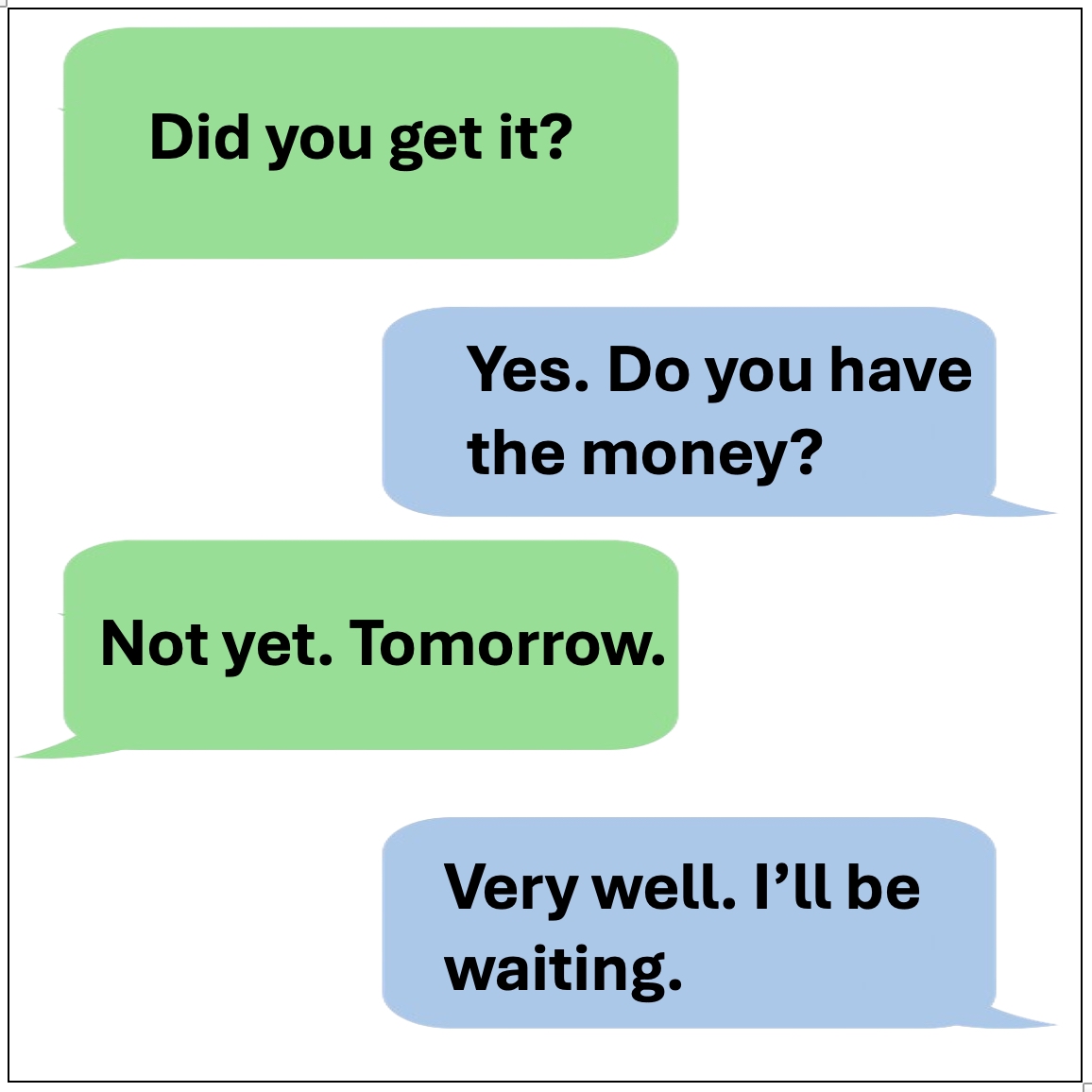
Graphic by Peg Ihinger
There are very few novels that don’t depend heavily on dialog for everything from plot exposition to characterization. So if you want to write novels, figuring out how to get the most from dialog is important. (If you want to write plays or movies, it’s even more important, but that’s not really in my wheelhouse.)
The logical place to start talking about dialog is with what the characters say. That’s what dialog is, right? Except that in novels, dialog rarely stands completely alone. Just as real-life speech includes both spoken words and body language, dialog in a novel includes both the spoken dialog and some or all of the narrative around it. You rarely find a dialog scene that consists of nothing but the quoted speech (meaning, no speech tags and no description of body language, setting, or anything else that might be going on).
So today I’m going to talk about all the parts of writing dialog that aren’t actually writing dialog—the stage business, speech tags, body language, reactions, and interior monolog that go along with having a conversation between two people in person.
Perversely, the first thing I want to talk about is the technique where the author does none of those things. They deliberately provide the reader with a scene that contains only what characters say. The writer uses no stage business and no speech tags. There is no hint, other than the phrasing of the dialog itself, as to who is talking or where they are, no indication of tone of voice, no body language, no internal reactions. The conversation is just voices overheard in a void.
When this technique is applied for a line or two in the middle of an established conversation, it’s usually already clear who’s talking, where they are, what they’re discussing, and why they’re discussing it. In this case, the writer is often trying either to focus attention on a specific line or to vary the pace. Sometimes, it happens because the writer is deliberately or unconsciously putting the dialog down first, planning to go back later and add the who-where-when-why supporting elements.
When the writer writes an entire scene that is nothing but unidentified voices overheard in a void, it’s usually intended to give the reader a “sneak peak” at a threat or key plot point that the characters don’t know about yet. It’s generally a short scene that feels even shorter and more fast-paced because the dialog itself is brief. (“Did you get it?” “Yes. Do you have the money?” “Not yet. Tomorrow.” “Very well. I’ll be waiting.”) This focuses the reader’s attention on the dialog, because there isn’t anything else there. The conversation can range from two unknown people planning to murder another unknown person, to two voices discussing something confusing or mysterious.
The key to making a no-narrative dialog scene work is the eventual payoff. The writer is implicitly promising the reader that eventually, they will find out who is talking, what the mysterious plot is and why they’re involved in it, and why all of it is important. And because the writer chose to hide most of that, there is usually the added implication that the answers are going to be unexpected and clever. It’s not the villain who’s planning to murder someone, it’s the hero. The discussion isn’t about stealing the secret plans, it’s about blowing up the docks.
Promising the reader a clever, unexpected payoff and then under-delivering is seldom a good idea, which is why this technique doesn’t get used too often. Which brings me to the dialog-supporting narrative bits.
There are three types of narrative that are there to support the dialog: speech tags, body language, and stage business.
Speech tags are all the variations on “he said”: she asked, they shouted, Susan stammered, George retorted calmly, etc. They tell the reader who said something and how they sound when they say it (tone of voice, loudness, vocal qualities like “raspy” or “smooth,” etc.). Much of the time, said or asked is all you need, unless the scene is deliberately melodramatic or nobody is talking the way you’d expect based on what they’re saying. (“Hush,” he whined. “Never,” she whispered. “Go jump in a lake,” Rachel agreed lovingly.) There are tons of lists on the internet of alternative verbs to use instead of “said,” if you insist, but they’re best used like the salt in a bread recipe, not like the flour. A little goes a long way.
Body language is what a character’s body is doing, usually unconsciously and involuntarily, that adds a layer of meaning to what they say: hunching their shoulders, putting their chin up, looking away, meeting someone’s eyes (or not meeting them), narrowing eyes, etc. If you’re in first-person or tight-third-person, body language and tone of voice are particularly useful for letting the reader know when non-viewpoint characters mean more than they’re saying out loud, because unless your viewpoint character can read minds, interpreting other people’s tone and body language is all they have to go on.
Stage business is anything else the characters might be doing during the conversation. Usually, people don’t just sit staring at each other blankly while talking. They fidget, they pace, they look out the window or study the bookcases, they choke on their drink, they pour another cup of coffee. Most stage business is relatively inconsequential. It can hint at non-viewpoint characters’ thoughts, but it’s not always as useful as body language in that regard.
One possibly-useful way of learning to see body language and stage business is to pick a movie you haven’t seen and watch it with the sound off, noting all the little things the actors do that let you know what’s going on. This can give you a place to start and/or a list to start from, though you still have to figure out how to get it down on the page.


o/ Hey! Sorry — this isn’t connected to the post, so please feel free to delete, but it was the only way I could think of to contact you: are you aware your Facebook account has been hacked (again)? Since about April it’s been posting clickbaity crap and AI generated posts and for some reason has a weird obsession with Jennifer Marrs.
You’re probably already aware of this, but it’s really sad and frustrating to see an author I respect targeted like this. I hope you can get your page back. <3
Yes. The problem is that the account is a fan page run by one of my publishers, so they have to be the ones to report it, which adds even more time to the reporting process.
“There are tons of lists on the internet of alternative verbs to use instead of “said,” if you insist, but they’re best used like the salt in a bread recipe, not like the flour. A little goes a long way.”
I mostly use the others to avoid unwanted adverbs. I prefer “shouted” to “said loudly” or something similar. Purely from personal taste, though.
“You rarely find a dialog scene that consists of nothing but the quoted speech (meaning, no speech tags and no description of body language, setting, or anything else that might be going on).”
Agreed. I did interludes in my latest first draft, but only because they are ~memories~ intruding on the protagonist amid myriad phantoms and hallucinations.
I did something similar late in the novel, at the revelation climax (which comes after the action climax and emotional climax*), to evoke something similar even though the last passage is a phone call.
(*That’s something I’ve found I do, not something necessarily to be found in a lot of works, or to strive for either. It’s just me.)
Meanwhile, I think I pulled it all off, but we’ll see in a couple of months when I do revisions.
Thoughts:
For some reason I was expecting a post about, or partly about, all-narrative ‘dialog’ scenes where a discussion is reported narratively without any actual dialog.
My personal preference as a reader is for generous speech tags to help me keep track of who said what. (I once was a beta reader for a work where the sparseness and odd positioning of the dialog tags drove me nuts.) And as I prefer to read, so I write – generous with the dialog tags.
Dialog is not something I get for free, but I find it easier to learn by study than certain other elements.
Gestures are on the border of body language and stage business – he nodded, he waved a hand in permission, he offered a false smile…
This is especially important when you have intrusions. If a gust of wind rattles the winds it throws off the give-and-take.
Or if there are more than two speakers present. After Alice speaks, is the next line of dialog from Bob, Cathy, or Dan?