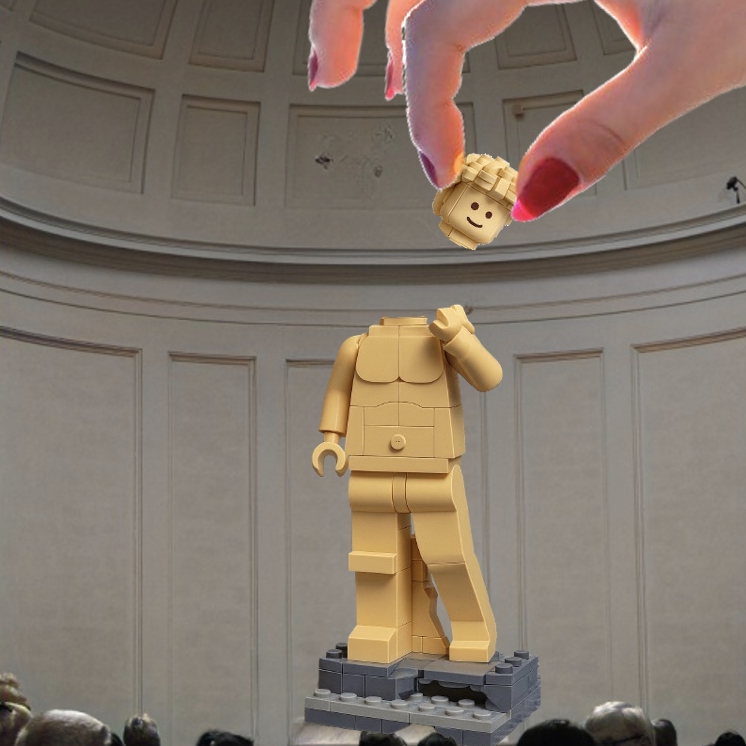
Graphic by Peg Ihinger
When it comes to characters, one of the first things writers are told is that characters should be “well-rounded.” This is usually followed by advice like “know your character’s purpose” and “give them flaws.” Sometimes, there’s more specific advice, such as “demonstrate (i.e., “show”) characterization in actions and speech.” Very occasionally, somebody provides specific advice, like “give characters distinct speech patterns and characteristic actions.”
What you seldom get is a reminder that none of these things are interchangeable Lego blocks. They’re more like a lot of really weirdly shaped puzzle pieces that have to fit together to make a believable picture.
This is compounded by the fact that unless you’re writing some version of Robinson Crusoe, you aren’t going to have a bunch of characters who are each standing somewhere in lonely splendor. These characters are going to have to interact with each other in believable ways that writers have to take into consideration. They also have to fit their role in the story.
Note that “fit together” does not mean “fit together perfectly” for any of the above situations. Individuals are inconsistent, and often want two or more mutually incompatible things at the same time. Group dynamics, mediation, and consensus building are common phrases because of how frequently people don’t get along with each other even when they’re all supposed to be on the same team, working toward the same goal. Even story roles are flexible—the main character may be a Grade A hero, a muddled protagonist, or an outright anti-hero, depending on the story.
A writer who just slaps down a bunch of traits is liable to get a pile of things that either don’t add up realistically (a nervous, lazy, exuberant, cynical, introvert), or that add up to the same thing (an obsessive, controlling, fanatical workaholic). This can sometimes work, if it happens for only one character in a story, but if every character in a story is unrealistically one-note or unrealistically random, it gets obvious very quickly. It’s also not something one can get away with repeatedly, except maybe in a series revolving around the same one-note character (who can be presumed to have the same personality throughout).
Most writers figure out fairly quickly that they need more than a bunch of random answers to questions like “what slang does this character use?” or “what is this character’s purpose/motivation/greatest fear/worst habit/etc.?” On the other hand, one has to start somewhere.
For pantsers and some planners, “somewhere” is Page One of the story. These are the folks who write their way into their characters—that is, they start writing and see how the characters develop. One writer famously doesn’t even give their characters names until the rough draft is at least half done. Working this way usually means a fair amount of revision on the early part of the story to keep the characters consistent.
More commonly, writers build characters to some extent before they start the rough draft. There are walk-into-your-head characters, who show up without being asked and demand a story (or take over one that’s in process, much to the disruption of the writer’s plans), but they’re rare and uncontrollable. They’re great when they happen, but you can’t force them.
Top-down characters, for me, usually start with their roles. This can be their role in the story—hero, villain, sidekick, mentor, love interest, traitor, minion, etc.—or it can be one or more of their roles in their world (a character can be both a king and a father, a lawyer and a Little League coach, a retiree and a fisherman, etc.). Characters, like real people, have multiple roles simultaneously, some of which can change over time.
The character’s story role is important to me mainly as a gage of how deep I need to go into the character. I need to know a lot more about my protagonist than I do about the security guard who appears for two lines on Page 136, for instance.
Thinking about the character’s roles in their world tells me more about the person, even if that role isn’t active for them anymore. (Every person is, or was at some point, a child; everyone has or had parents, even if they’re now an orphan. After a certain age, most people learn how to make a living, whether they’re self-taught, apprenticed, trained by family, or sent to school.) Because a lot of roles begin or end with milestones (leaving home, graduating/completing an apprenticeship, earning a degree, marrying, etc.), thinking about a character’s experiences in that role usually ends up with a timeline of significant moments in the character’s life.
From there, it’s usually a matter of bouncing back and forth between the character’s personal history, things I know I want for the plot (e.g., “this character’s parents were murdered when he was ten”), and worldbuilding (“this character was apprenticed…how, exactly, does the apprenticeship system work? Are there guilds? Oh, hey, maybe I can use that research on the Hanseatic League…). It’s like pinball, where the point is to keep the ball of my attention bouncing around collecting scraps of plot, characterization, and worldbuilding until the story hits critical mass.
Bottom-up character building is harder for me, because it usually does start with a couple of random character traits. I have to consciously test things until something goes “snap” and I start to get a feel for the person. At that point, it’s back to plot/world/character pinball.
Ultimately, what I need is a feel for the character. Lists of traits don’t do it for me as a starting point, though they can sometimes be helpful once I have a bit of background and a feel for the character (as in, “Oh, hey, I hadn’t thought about that, but if these things happened to her in the past, I bet she does have this kind of PTSD…good to know).


I’m not as theme-focused as I used to be, but since my imagination always wants to take off and introduce all sorts of things to my works, I always focus on something unifying to keep any chaos under control.
So if I’ve got a theme of abuse of power, I might put in a character who’s been bullied, but if I include one whose main feature is trying to decide between two prospective mates, that character is just going to distract and detract from the story.
I absolutely agree about a feel for the character being paramount. When I can see them in my head and know who they are, I’m all set.
Almost all of my characters are walk-into-my-head types, but that doesn’t correlate to uncontrollable. Their role in the story is part of what they walked into. Protagonists may nag at me or have ideas I didn’t anticipate, but it nearly always either stimulates the story into existing in the first place, or fits into the story-so-far. And lesser characters pretty much stay in the slots they came into existence for.
Which does not mean they don’t develop (or come with) personalities! Even in the current WIP, where I’ve had to deliberately add characters to get the cast size up to where I need it for Reasons — I’ve started with a demographic and a name, and they’ve promptly grown personalities and beliefs and speech patterns and backstories. (It’s given me increased sympathy for Our Hostess’s dislike of council scenes, because since they have personalities, every time there’s an event, they all have reactions or opinions. Sometimes I can get away with “the rest of the group did such-and-such”, but more often it’s the laundry-list of responses.)
Characterization is one of the cards I got dealt for free. Which is helpful to absolutely nobody else, I realize. But I really hate the meme that pantsing = massive amounts of revision; I know it works that way for a lot of people, but I feel the need to represent for those of us who wing it and still manage to lay down an internally-consistent story on the first pass.
The one thing we all seem to have in common is needing to have a feel for the character. For me, that generally comes as soon as they appear on the page. It grows and develops over time, sure, but much the way you get to know more about a real person as you become friends with them. Doesn’t mean they’re not still the same person you met in the first place.
For me, names are Magic. Without a name I have, at best, a vaguely character-shaped bit of idea-fog. If I’m in the middle of writing and find that I need a new character, the writing comes to a stop until I get a name. And sometimes it isn’t even a person I need the name for. It might be, e.g. the name of a grocery store or a tavern.
After the name comes what I call the “concept.” Which is not the role but something that plays pinball with the role. It commonly starts off as a sort of elevator pitch, but for a character instead of for a story-plot.
I’ll note too that my stories often have characters who get left out because it turned out that there weren’t roles for them in the story.
How very true. Names have baggage, so I know I have defined the character if I have a name.
My characters tend to appear in situations, which means I need to work on what they are like when different things bring out different aspects.
I started the WIS with “how can I keep the alien animals in their zoo enclosure safely?” (I was at the National Zoo at the time–went home and wrote a thousand words, and it just took off from there.) This needed someone to be keeping them, of course, but I knew *nothing* about her other than name, gender, and occupation.
She turned out to be a bafflingly specific person, given that generic start. Also a person deep in denial about fundamental things (like being a telepath)–so that she never thought about them, which made them hard to discover.
I do want to make a revision pass and try for a few more hints about what she looks like, though, and a little more about her esthetic preferences. I am *very* poor on what people look like; I’m face-blind myself and it’s really low salience for me, but intellectually I know most readers aren’t like that.
My characters arrive fully formed—like Athena springing from the brow of Zeus—and I learn about them by seeing what they do and how they respond as I write. Pity me if I try to change any aspect of them or try to tell them what they can or cannot do.
On inconsistency: the most useful piece of advice I’ve ever read about making well-rounded character is to introduce contradictions. Is he lazy or hard-working? Well, yes.
The advantage of that is that if they are plausible, you can introduce real doubt about whether he will work hard on something.