Graphic by Peg Ihinger
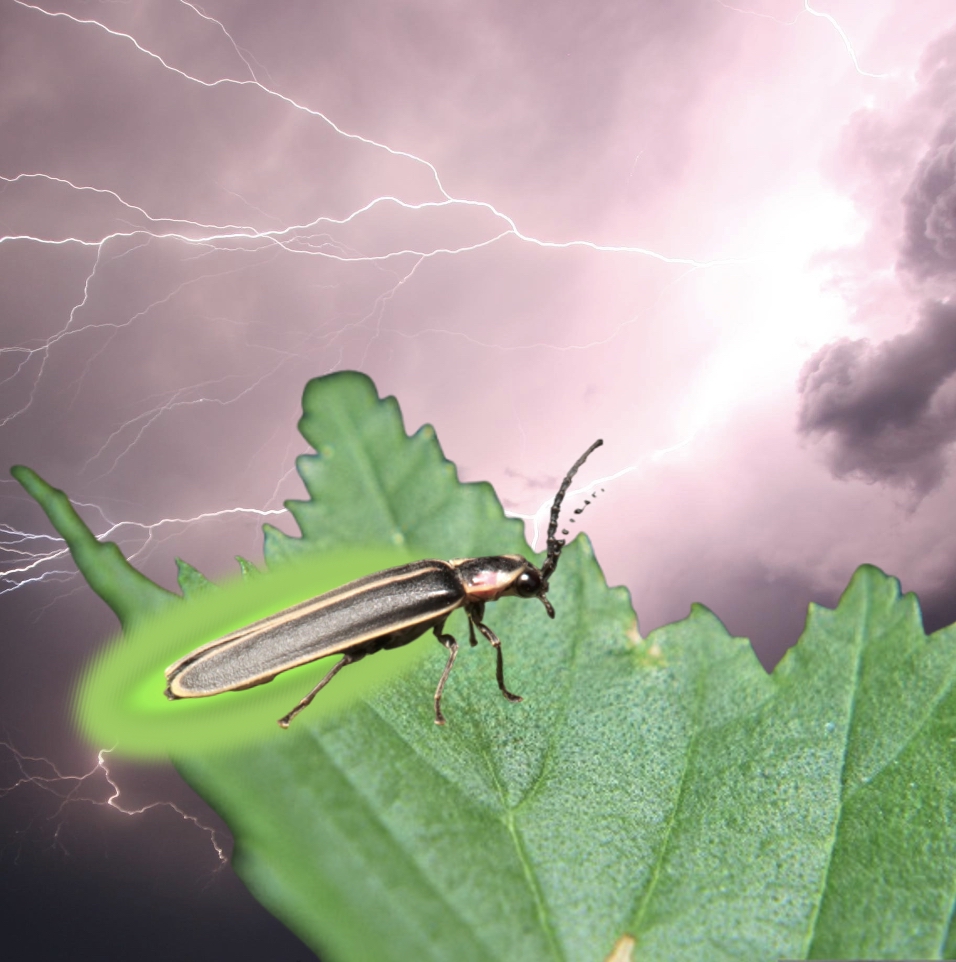
A lot of writers have talked about the importance of choosing the “right word,” from Gustave Flaubert’s “le mot juste” to Mark Twain’s “the difference between the almost-right word and the right word…is the difference between the lightning bug and the lightning.” We talk about this because it’s important. But why is it important? And what does “the right word” mean, anyway? How do you know it’s right?
Choosing the right word is important because words are what stories are made of. The particular word you pick can affect everything in a story: tone, pacing, clarity, voice, characterization, action, readability, and on and on. The words the writer chooses, and the way the writer uses them, give the reader immediate clues about genre, Heinlein’s “The door dilated.” being one of the better-known examples.
So picking the right word is important because of what the right word does that a different word can’t (or simply doesn’t) do. Which brings me to what “the right word” is.
I would contend that the right word is the one that does the best job of delivering whatever effect (or effects) the writer wants delivered at that moment in the story. “Lightning” is not a better word or phrase than “lightning bug.” That famous Twain quote wouldn’t be nearly as memorable if he’d said “…the difference between a glowworm and the lightning.” It needs both of those words for its dramatic contrast.
Which word is “the right word” therefore depends on what the writer is trying to do, beyond the basics of, say, “describe a night scene.” If the writer wants a peaceful summer night for a romantic encounter between the main characters, lightning bugs will probably be a lot more effective than lighting. If the writer wants a dramatic rescue in a thunderstorm, lightning is obviously the preferred choice.
Of course, the majority of the time, writers are doing several things at once. Because picking “the right word” can (and does) affect so many of those things (tone, pacing, etc.), this means that the writer often makes their decision based on which of those things they feel is the most important at the moment. If “lightning bug” picks up a recurring lightning theme that “glowworm” doesn’t, the writer may choose the three-syllable “lightning bug” over the two-syllable “glowworm,” even though “glowworm” makes the sentence scan better.
Context is also important. One doesn’t usually want to use words like “adulting,” “biohack,” or “binge-watching” in a historical novel set in the 1600s, or even one set in the 1950s—not unless the viewpoint character has time-traveled from the 21st century.
A lot of these decisions get made intuitively (though, speaking for myself, when I’m working with historical or alternate-universe settings, I often have to consciously stop and eliminate words that are too modern-day). One key indicator that there’s a word choice problem is the word that keeps changing back and forth between two options—today, the sentence says “glowworm,” tomorrow, it’ll change to “lightning bug,” next edit it’ll shift back to “glowworm.” That’s a signal that the writer has two different effects that are important here, and one word hits perfectly on one effect, while the other is perfect for the other effect. Once one realizes this, one can search for a third possible word or a rephrasing that will provide both effects, but if that fails, one can only grumpily decide which of the two effects is most important, and pick the word that provides that one, letting the other go.
Lots of writing advice recognizes all of this. The problem, from where I sit, is that the advice they give nearly always start with something about how much more vivid the imagery is if the sentence reads “The tiger stalked forward” rather than “The tiger walked forward.”
Which, again, is quite true (if the tiger is indeed stalking), but “more vivid imagery” is only one of the things the writer can do with words. Yet once one starts with “the right word can create more vivid imagery,” it’s a very short step to “the right word must create more vivid imagery.” And the rest of the advice underlines the must if most of the examples that follow continue to demonstrate “more vivid imagery,” even when they’re supposedly trying to be examples of “the right word” changing tone, or voice, or clarity, or characterization, or whatever.
I think this happens because vivid examples are more memorable, and “remember this advice” is the effect the advice-writer wants. So they give an example that replaces “said” in speech tags with “something more precise” like “caroled” or “stammered” or “bellowed,” without considering the effect that all those dramatic, vivid speech tags will have on the tone or the voice or the readability of a page of dialog (let alone the effect over an entire novel).
I have never seen a “right word” discussion or example that talks about “said” being the right word (though I have seen one or two discussions of dialog and speech tags that do, and a couple of “right word” discussions that finish up with an acknowledgment that the right word isn’t always the longest, most unusual, or most obscure bit of vocabulary).
Unfortunately, when most or all of the examples in an article show words like walk, red, say, and look being replaced by “right words” like prowl, crimson, pontificate, and glower, readers can easily get the impression that it’s drama that makes something the right word, and simple or “generic” words can’t ever be the right one.


Ironically enough, I’ve thought for a long time that the Twain quote would carry more impact if it were “…the lightning bug and the lightning bolt.” YMMV.
I once sat down and wrote, “This is folly.” Answering all the questions those three simple words implied started me on my first novel—though I didn’t know that’s what it was at the time.
“Folly” is not a word likely to be used by someone from modern-day New Jersey, and indeed those two syllables suggested (demanded?) a fantasy or perhaps historical setting—as well as suggesting aspects of the personality of whoever said it. The right word (or any word, for that matter) can carry a lot of weight.
Also, of course, the cumulative weight of all those choices produce the effect. Botching even a hundred choices is unlikely to ruin a novel, or even produce a glitch as long as it isn’t egregious.
On the other hand, you can’t write the cumulative weight except through careful consideration of them, one by one by one.
A few things to consider in picking a word (obviously there’s about a million):
– Is there alliteration? “Packs a powerful punch” is cliche by now, but “Packs a powerful wallop” is less memorable.
– How’s the rhythm? “I have to say I just don’t know” has some rhythm without being singsong; “I have to articulate that I have no particular recognition” falls flat.
– Is it evocative? Our hostess pointed out why you don’t want to make too much of this (so please don’t), but for a dramatic moment, “Right then I knew I had to depart” is a bit bland compared to “Right then I knew I had to run.”
– What about parallel structure? I suspect this is a much bigger deal in nonfiction, where I had to work hard to hammer it into the novices (and it mattered a lot more in lists), but a sentence that starts with Anglo-Saxonisms, like “He yanked out a knife and came in fast” maybe shouldn’t be finished with a phrase containing a Greek/Latin-derived word like “aiming to perforate me.”
As always, use with judgment. And ignore if it doesn’t help!!
Book 1 of this thing I’m writing has the main characters learning about unfamiliar concepts, people, and places from contacts who are pure telepaths and don’t name things. The main characters are language-users, so they have to name everything. Those word choices have turned out to be critical. They have to be clear enough, flow well even when used repeatedly, and express the character of both the named thing and the ones giving the name.
Their hive-mind ends up calling itself (themself? themselves?) “Valley-colony” and I kind of wish they hadn’t: it’s a bit awkward. They know it, too, and are “the Farspeaker Guild” when talking to outsiders. Don’t know if I can dissuade them, though.
I also, as can be seen, have pronoun problems. Is “themself” even a word? I use it quite often. I also equivocate over whether Valley-colony is “it” or “they.” Maybe the equivocation is expressive of the ambiguity they feel: maybe it’s just confusing.
In the chapter and a half at the end of book 1 which are from Valley-colony’s POV, I use “they” for the POV throughout–boy was that hard to write. “It” is even worse, due to overloading. I have a chapter somewhere from the point of view of an individual (isolated) alien, who has not yet met any humans and really has to be “it.” But this constantly conflicts with other uses of “it” in the same sentence (“It was not sure whether it was raining”, argh). Giving that character a very short nonce-name so I could repeat it constantly helped a bit. If I did a whole novel of this, though…I guess I’d get better at it.
Just realized how much trouble the naming conventions in _Nona the Ninth_ must have caused its author. Naming people “We Suffer And We Suffer” and “Born In The Morning” is all very well until you have to fit them into an arbitrary sentence, or make possessives, or have more than one such name in the same phrase!
She makes it look reasonably smooth, but not effortless: I suspect this means it was *hard*.