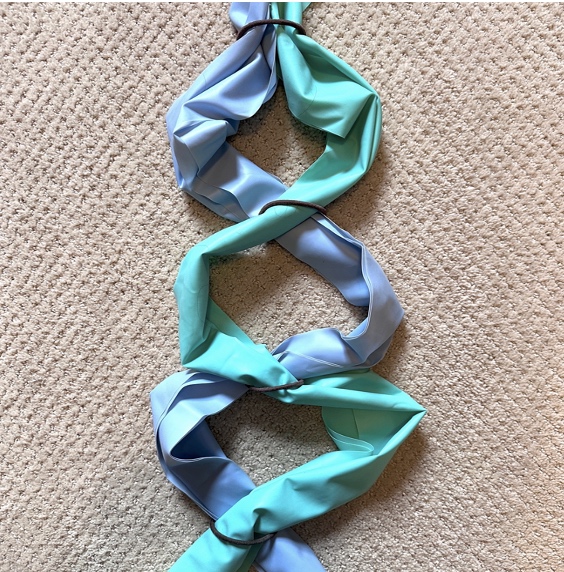
Graphic by Peg Ihinger
It’s been a while since I talked about structure, and Rose’s question in the last Open Mike made me realize that I normally talk about structure in general, not about specific story structures. So this time, I’m going to dig into alternating storylines.
I’m not talking about plots and subplots here. I am talking about a structure that alternates between two separate but related storylines in a mostly-regular rhythm. The two storylines can be in alternating scenes, alternating chapters (which is the most common), or even alternating sections, depending on the story that’s being told. It’s very similar to the multiple-viewpoint structure, and has some of the same advantages and pitfalls.
In order to make this kind of story work as a single novel, rather than as two completely different novellas that have been randomly cut apart and shuffled together, the two storylines have to be linked somehow. The link can be a single plot, as when one storyline follows the serial killer meticulously planning his next victim, while the other storyline follows the detectives trying to catch him before he kills anyone else. The link can also be alternate plots, as in Jo Walton’s My Real Children, where each storyline follows an alternative timeline that the main character might have lived. The link can be time itself, as in Ian Banks Use of Weapons, in which the two storylines follow two different parts of the main character’s life. The link can be thematic, as in Peg Kerr’s The Wild Swans, which alternates between two very different but thematically related retellings of the titular fairy tale, one a straightforward retelling set in the 1600s, the other a more allegorical version set during the AIDS epidemic of the 1980s. Robert L. Forward’s The Dragon’s Egg contrasts time and plot–one storyline follows the humans who are investigating a neutron star and making a first contact with the aliens who live there, the other follows the aliens, who live at high speed, such that civilizations rise and fall, over the course of an hour or two on the human side.
In other words, two alternating storylines have to have some kind of link between them, but the link can be practically anything.
The catch is that both storylines also have to be strong enough and interesting enough to keep the reader interested in them. This is less difficult when there’s a strong link, as in a serial-killer plotline, where there’s a single, overarching plot that each storyline is following. This is because each storyline is developing one primary story, just from a different direction. Each scene or chapter will make progress on the novel storyline, which drags the reader along even if they aren’t quite as interested in what’s going on in that chapter. The overarching plot acts as a throughline.
When the link between the storylines is less obvious, each storyline has to be interesting and involving on its own merits. If the reader gets to the end of a chapter, sees that the next one is about an alternate storyline, and skips that chapter completely in order to “get back to the real story,” the structure isn’t working effectively.
“Interesting and involving” is, of course, a moving target. Different readers (and writers) have different preferences. The thing to remember is that both of the storylines in an alternating structure need to appeal to the same reader. If one storyline is a slam-bang science-fiction action-adventure and the other storyline is a slowly unfolding literary psychological study, the resulting novel is like to appeal only to readers who like both types of story…and even they may be annoyed by the whiplash of switching reading gears every chapter or scene.
There are a couple of ways to keep readers interested in alternating storylines. I already talked about the strong plot-link, when each scene contributes to a single main plot, converging on the same climactic moment, regardless of which of the alternating storylines the scene is set in. One can get the same effect with a time-and-character link, where both storylines cover different parts of the protagonist’s life.
For example, Brust’s Taltos could have been told “in order” (that is, putting all the scenes in chronological order as a single story), but for my money, it wouldn’t have been nearly as interesting, nor as smooth. The storyline that covers the protagonist’s life from birth to the start of the “main” storyline might lose a lot of readers if the novel spent the first five or six chapters on it, because it’s a long, slow build. By sandwiching it between the central action and the long, involved spellcasting, the reader gets the background in smaller bites, once they’ve already gotten interested in the protagonist and the troubles he’s having in the current timeline and want the long, slow answer to “How the heck did this guy get into this mess?”
An alternative is for completely different stories to be linked through protagonists who have a very similar problem, but who make very different choices about what to do about it. There are several novels in which one storyline follows an archaeological expedition, while the other follows the lives of the people who live on the site centuries before, and left behind the items the archaeologists are arguing about.
Ultimately, the link can be almost anything that can be an answer to the question, “Why are these two different stories being presented in the same novel?” As long as it does actually answer that question.


In Captain Jax and the Space Pirates, I alternated chapters between a stowaway on a starship and his sister’s attempts to get him safely back home. I never thought of it as structured as alternate storylines but rather simply change of scene, as it is a single story told from two viewpoints.
What distinguishes one from the other?
Nothing. Writing terminology is not standardized, and there are a LOT of things in fiction writing that can be classified in more than one way, depending on whether you are looking at it through a plot filter, a character filter, a purpose filter, etc. How one views a story affects how one thinks about it and develops it. Structure is also one of those things that many writers do intuitively, which often makes it hard to see why one is telling the story that way (much less what additional things a particular structure might add if one tweaked it a little).
Other things to *help* unify the storylines can be a visual motif repeated between the two, or lines of dialog that echo each other.
Little things like that can help, but I would think you’d need something more, as in the things our hostess mentioned above.
As a reader, I’d also suggest not leaving every chapter on a cliffhanger. I’ve seen alternating storylines done really well: Taltos, as mentioned above, Silence Fallen by Patricia Briggs, and Beguilement and some of the Penric and Desdemona stories by Lois McMaster Bujold start out as alternating storylines (although those mostly converge to a single story with alternating POVs before the halfway point).
But the comment about wanting to get back to the real story took me right back to Maggie Furey’s Heart of Myrial, a book I haven’t thought about in years. It had 3 or 4 alternating storylines and at the end of every chapter, there was a cliffhanger or a hook, so you really wanted to find out what happened next. But by the time you read through three other chapters, and were trying to remember all of their situations, you’d half forgotten what had happened to character one when you last saw them. And the storylines did not converge until right near the end of book one. I think I gave up on the author’s structure, and started skipping chapters to read character one’s story, then back for character two’s story, etc. It was not a keeper.
And of course, there’s no hard and fast line between alternating storylines and a main and sub plot. It’s clear in Even After that Biancabella is the main character, but several storylines follow other characters. Particularly Constance, and then John.
Which does not correspond with how important the characters are.
Do you think It,s good to make some charter inside the villain heidän in dephts of craziness? Or if It,s good to make charter about other people and Come back to the heroine?
There is no one true answer to this question. For some stories, it’s a good idea. For other stories, it’s not. It depends on the story, the writer, and what the writer is trying to do with the story.
Even if each storyline *is* interesting and involving on its own merits, this sort of structure can backfire. I remember several Star Trek novels (by Diane Duane, IIRC) which had one historical plot/timeline which influenced the situation in the second, current-day plot as well as having a thematic connection. Both were engaging, but the end result of that was that I was annoyed *every* time I got to the end a chapter and had to switch! I’ve always meant to go back and reread them as separate stories…