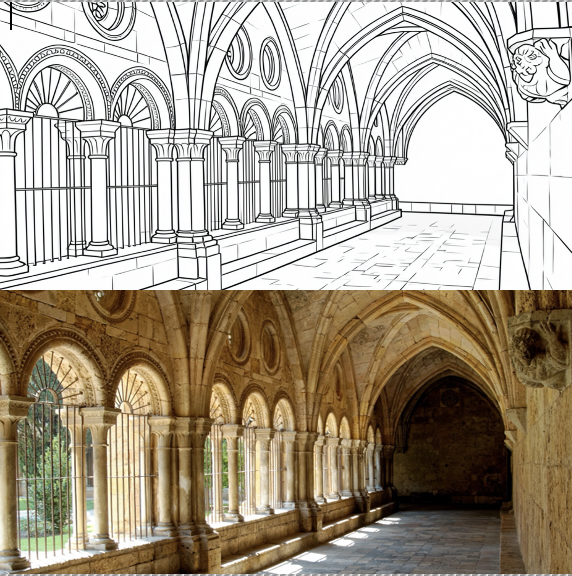
Graphic by Peg Ihinger
Let’s talk about setting for a minute.
For purposes of this post, the setting is not just the physical location (geography, buildings, flora/fauna) of the story. It encompasses all that, plus things like the history, politics, culture, and customs of the people who live there. This can also include the backstories of the central characters.
As a result, writers face constant choices between saying “a forest” and “an old-growth forest of pines that soared over a hundred feet in the air over a five-inch thick layer of fallen needles” or between “a monastery” and a two-page infodump describing the architecture, history, and current routines of the inhabitants.
Both the completely generic choice and the two-page infodump are valid choices. Whether one of them is the right choice for a particular story is a different matter, depending on things like what is going on, pacing, and available word count (short stories have far less room for long descriptions; action scenes may need more specifics than the writer initially thinks in order to establish the existence of the barrel the character trips over or the frying pan they use as a makeshift shield).
Infodumps are not a bad idea or a forbidden technique. Boring infodumps are the bad idea.
Now that that’s out of the way, there are four things a writer needs to consider when working out which setting details to use and when to use them:
- What the reader needs to know in order for a scene or a story to work. These are the objects, customs, etc. that the scene needs or that set something up for later on. Chekhov’s famous gun on the mantlepiece, for instance, or the chair the protagonist trips over in another three paragraphs, or the fact that not offering to exchange knives with a new acquaintance is a grave insult.
- What readers are going to expect, assume, or fill in on their own if the writer uses the most minimal, generic description. Sometimes, many or even most of the specific details are unnecessary. “Over the next three weeks, they passed through fields, several hamlets, and a small town” usually doesn’t need more details about any of the locations. The writer has the opportunity to choose to add more specifics to these brief descriptions, which can add richness to the worldbuilding, atmosphere or mood to the story, and possibly set something up for later without being terribly obvious, but one is not required to take advantage of every opportunity.
Thinking about readers’ expectations also allows the writer to deliberately undercut those expectations by providing unexpected details: “the medieval library” that contains only cubicles with VR helmets; “the palace” that is laid out like a Best Western hotel; etc.
- What are the unique features or aspects of the setting, also known as “if your reader suddenly woke up in this place for no apparent reason, how would they know they were in this place and not a generic tavern, forest, city, etc.?” What makes this place different from any and every other tavern, forest, palace, monastery, city? Which elements of the building, furniture, customs, etc. would most readers find unexpected and surprising, exotic, or just really strange? Which ones would the characters find unusual, startling, or memorable?
- What things would the viewpoint character notice or react to in ways that a reader would not? This is where a lot of how-to-describe-stuff advice starts, sort of, because what the POV notices is partly a characterization thing. But it is also a setting/worldbuilding thing, especially when the viewpoint character’s reactions differ from those of the expected reader.
For instance, a character who is stunned by the waste and expense of using wood as fuel, probably comes from a place where wood is a rare and expensive import, like a desert or arctic area. This tells the reader both something about the character’s background and something about the world (that some places are inhabited in spite of their lack of certain resources the reader would consider commonplace).
The interaction between these four things is one key to providing readers with information about setting that is interesting and likely to be useful. One the writer knows what readers and characters expect or take for granted and which things they’d notice or find memorable and surprising, it’s easier to make a setting interesting and alive.
A two-page description of a medieval tavern in a fantasy novel that details every scratch on the trestle tables, every bench that’s sticky with spilled beer, every barrel behind the bar, every drunk moody elf and rowdy dwarf, and every torch trying to light the dim, smokey atmosphere often struggles to hold readers’ interest, because no matter how beautifully it’s phrased and how accurate the details are, everything in it is exactly what the reader is expecting to find in a fantasy tavern. A two-sentence description can be much more interesting even if it limits itself to the slightly ratty stuffed unicorn head hanging over the bar, the two-foot high door in back that has “Gnomes Only” written on it in elegant silver-green letters, and a locked cupboard behind the bar that contains wine bottles that glow bright blue, one of which is half-empty.
The short version holds attention for two reasons. First, it’s a bit unexpected. It doesn’t confirm the reader’s expectations of a generic place, though the tavern may still contain sticky tables, barrels of beer, and drunk moody elves. It gives the reader a couple of touchstones that identify this specific fantasy tavern, distinct from all others.
And second, the specific details imply interesting things about the world and raise intriguing questions. Is unicorn hunting common? Where does that little door lead? Why is it even labeled when it’s too short for anyone but gnomes to walk through? What’s in those glowing bottles and why is one of them only half full? These questions may be totally irrelevant to the main story, and they may never be answered, but they make the setting more interesting without bogging the story down.


“Infodumps are not a bad idea or a forbidden technique.”
Writing exposition is a skill the same as any other. The more intriguing, suspenseful, evocative, lyrical, or, in a word, *entertaining* you can make your exposition/infodumps, the less readers will be bothered by them.
The worst form of infodump is a character explaining to another something that would be common knowledge, because the author can’t think of a better way to inform the reader. “As everyone knows, green eggs and ham have been illegal since Samuel III took the throne in 482.”
On the other hand, it is literally as old as the Iliad, so I don’t think it’s going away any time soon.
I’m not re-typing this:
https://writingandreflections.substack.com/p/dumping-the-info
And in prose, you can just TELL people things!
https://writingandreflections.substack.com/p/dumping-with-style
@Wolf: A/k/a “As you know, Bob.”
This is why it’s often convenient to have characters around (possibly the MC) who *don’t* know much about the setting, so that explanations are natural. This may even be structural: the group of hobbits come from a relatively ill-informed backwater. (https://rickellrod.com/2020/03/03/the-ignorant-interlocutor/)
Rick
OTOH, you do have to deal with that character’s presence thereafter.
The first several pages of Robin McKinley’s Spindle’s End are an infodump. For me, it worked beautifully, because I enjoyed the narrator’s voice and how they described the world. Without that voice it could have been tedious, but the voice made it work.
Sometimes you have to juggle things to get the right elements in. One of the best examples I have see of it was the dazzled heroine arriving at court for the first time, at dinner. One prince arrived late — thus giving her a reason to pick him out despite the general splendor.
One said in a writing Claes evening: “Elisabeth watched fron the Windows of the manor when mist Lingered to garden” well It wasn,t 2023 Finland.
This can be especially challenging when the writer knows a setting well, but readers may not. I’m currently writing a story set in the American heartland, in farm country. How much does the average reader know about farming? Based on conversations with some of my city-bred friends, not a lot. (When we bought our house, friends thought we could just nip across the road and help ourselves to corn-on-the-cob from the field there. Aside from the fact that that’s someone else’s property, they’d never realized that the “sweet” on the signs for roadside sweet corn stands meant it was a different variety than the feed corn we’d moved next to. Corn was corn, they thought.) The ways of tractors and plowing are mysteries that they don’t even realize exist. I’m no expert, but I grew up around it, so I’m constantly having to stop and check: does this make sense to someone who didn’t?
Especially when this is all second nature to your character as well
Definitely!!
I remember turning to the first page of, I think, Pride and Prejudice. (This was a while ago – but it was definitely Jane Austen.) I was expecting, basically, Georgette Heyer only more so…and it was all dialog. Dialog. No description!
Then I realized her readers wouldn’t need any, the setting and everything else was completely familiar. Oh…
I’ve revising a story in which the heroine, to my relief, has a reason to sit down with a history and a map.
The protagonist of my WIS managed to go an entire 6 chapters without ever noticing that Earth is now under a one world government, or that people expect to live to around 120-140, or…a lot of things. She was very insular and very focused on her work. (And then got abducted by aliens, so none of this comes up in the rest of the book either.)
Had a lot of setting work to do when I started book 3, and some of it involved rewriting parts of book 1 when I discovered that, very inconveniently, neither species has anti-gravity and I was going to have to figure out how one rotating ship gets boarders onto another. (Still working on that one. Not the way I wrote it the first time, that’s for sure.)