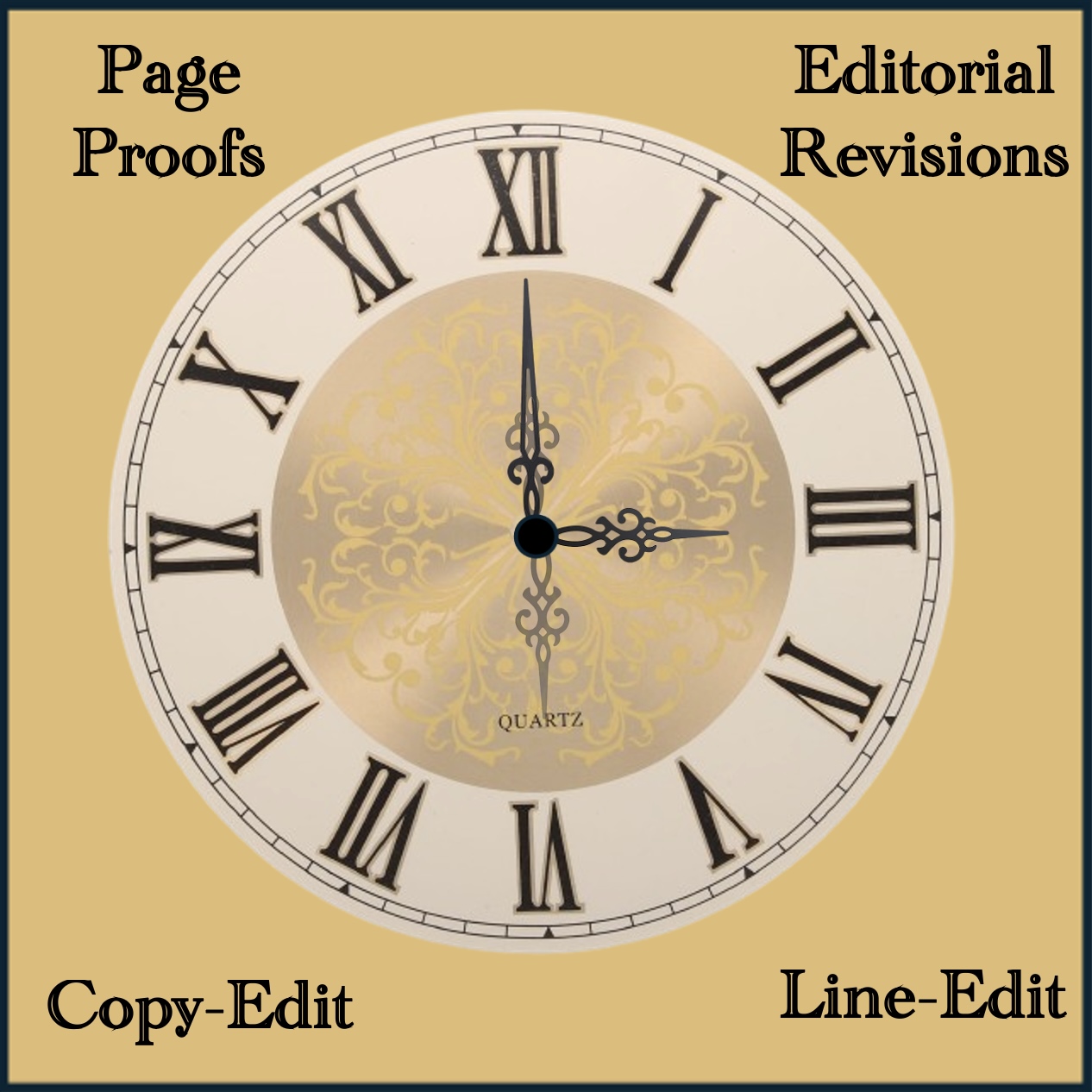
Graphic by Peg Ihinger
So I just finished the page proofs for How to Run Your Evil Empire, which has me thinking about the differences between writing the first draft, revising it, and polishing it. For those of you who haven’t discovered Elle Cordova yet, this video sums that part up pretty well: https://www.youtube.com/shorts/YqPPyGDfiDY
Which isn’t going to stop me from talking about it, of course, because what Elle was presenting was the process of going from ideas to submission draft (and the compulsion to make it perfect that drives writers to keep tweaking long past the point of diminishing returns).
What I am going to talk about is the revision process that happens after the book gets accepted.
For a traditionally published book, the post-acceptance revisions come in stages that are closely tied to the process of producing an actual physical book. These can range from two to four or more passes, depending on the publisher (and, to some extent, the writer).
The first stage is the editorial revisions. This is where the editor takes that perfect, polished submission manuscript and points out everything that is wrong with it: The pacing flags here, this character’s motivation is inconsistent there, this subplot is distracting, that scene can be cut, this narrative passage needs to be a scene, the dark backstory needs to be brought forward, and so on. (These are all actual examples, though thankfully they are not all from editorial requests on the same book.)
Editorial revisions are usually large and time-consuming. If they are large enough, the editor may ask for a second round to make everything flow better. Sometimes, the writer takes long enough that the editor gets promoted or the publishing house gets acquired, and their book is assigned to a new person who has a different idea of what the story needs. Writers can argue with editorial revisions and suggestions, and sometimes should, as this is where the “three o’clock problem” tends to occur most often.
The three o’clock problem is this: Picture a clock face. The manuscript is at three o’clock, which doesn’t quite work. The editor makes suggestions that will move it closer to twelve o’clock, assuming that twelve is what the author was trying for…but the author was actually attempting to hit six o’clock.
The solution is not “immediately rant at the walls for a week and then do what the editor suggested, because they’re an editor and they might retroactively reject the book.” First, the writer needs to find out whether or not the editor realized the writer was aiming at six o’clock, and if so, why they feel that twelve would work better. In my experience, either the editor convinces me that twelve really is better, or I convince the editor that six is the way to go. If convincing doesn’t work, the writer gets the final say . . . but this is a power that should be used with care. Insisting that one’s every comma is golden does not endear one to editors.
Editorial revisions usually take me at least a month or two, sometimes more, depending on how extensive they are. “Extensive” does not always mean “I had to insert a whole new chapter.” Sometimes it means “I had to insert one sentence in exactly the right place in every other chapter in the whole book.” (Editors have never asked me to do that specifically. But when they ask for “more tension overall,” sometimes that’s the only way to do it.)
The second stage is the line-edit. This is where the editor or their assistant goes through the book flagging awkward sentences and paragraphs, continuity issues, inconsistencies, infelicitous phrasing, malapropisms, over-used words, and other things at the sentence-and-paragraph level. This is usually not as time-consuming as editorial revisions, but it can still takes a couple of weeks (at least for me), because fixing the issues requires decisions that often have a ripple effect. Also, there are usually a lot of them. Some publishers combine the line-edit with either the editorial revisions or the copy-edit. Line-edit can take from three weeks to a month, again depending on the extent.
Third stage is the copy-edit. Copy-editors do the really nit-picky stuff: spelling, punctuation, grammar, capitalization. They also try to fact-check real-world references (not always an easy thing with fiction), maintain the publisher’s “house style,” flag anything they think isn’t clear, mark words that are repeated too often or too close together, and ensure the book’s internal consistency in everything from “how many hours does it take to get from X to Y” to “should this army be referred to as Dark Horde or Dark Hordes?” Going over the copy-edit usually takes me about two or three weeks.
Fourth stage is page proofs. This is the fully-formatted version of the interior of the book. Queries tend to be mostly the last few things that didn’t get caught at the copy-edit stage, plus occasionally things like “can you change something so this chapter doesn’t end with one word at the top of a blank page?” and “Where should we hyphenate this imaginary name when it has to break at the end of a line?” There are always more of these than I expect, especially the ones where I’ve reused a word with different meanings (“She turned left, and left the room”). Page proofs usually take me about a week.
Now that everything is digital, copy-editing and page-proofs and even line-editing can all be done on the formatted version of the book. Different publishers handle things differently. I’ve had publishers who have only given me two shots at the book (one that was editorial plus line-edit and one that was copy-edit plus page-proofs) and publishers who’ve sent me the formatted pages three or four times to make absolutely sure that the changes I made in the previous round of revisions didn’t cause problems with where lines break, or didn’t add just enough to a chapter to make it end on a page with a single word at the top.


Leave a Reply