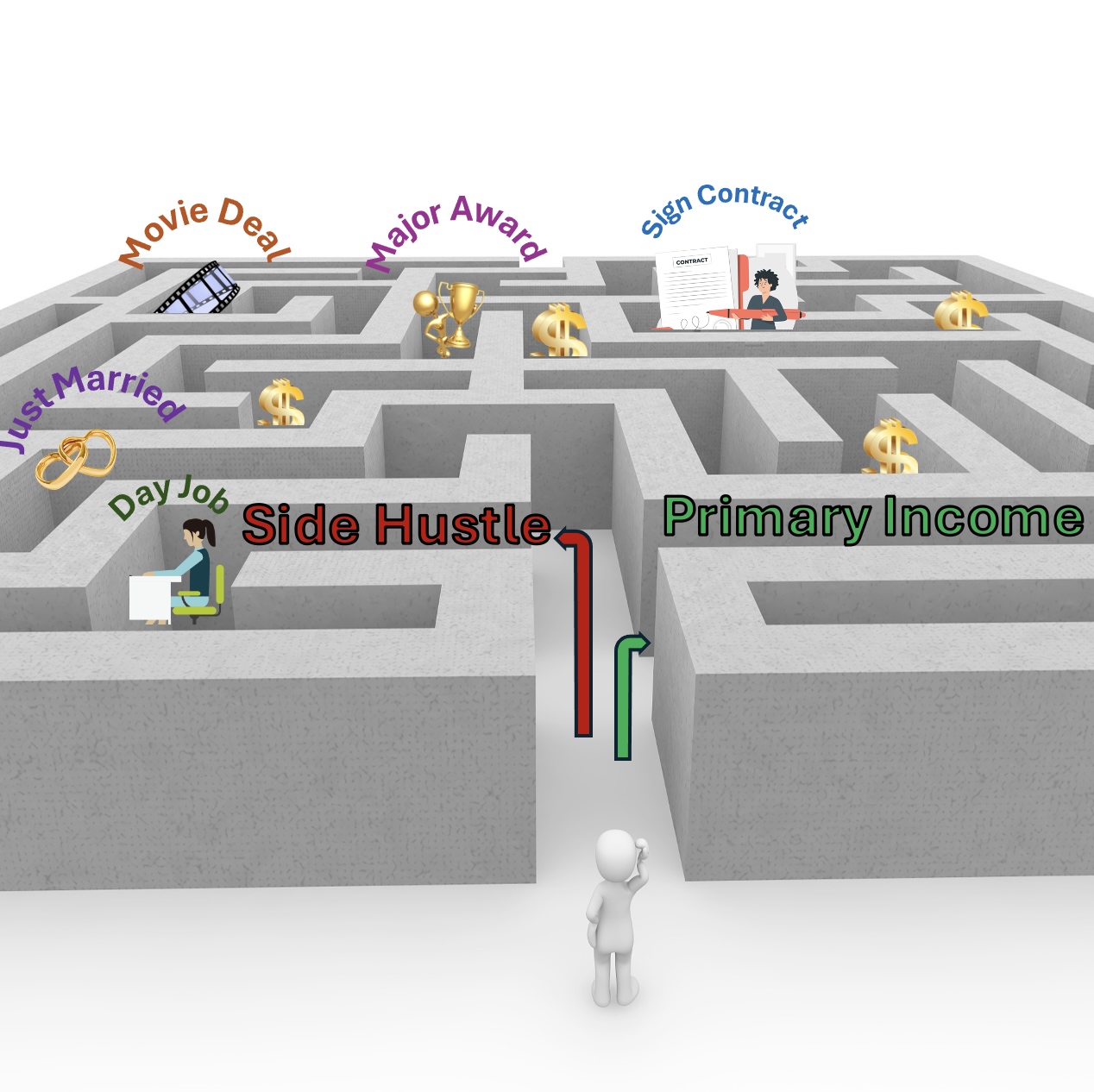
Graphic by Peg Ihinger
I sold my first novel in 1980, which is very convenient for calculating how long I’ve been at this. Back then, I expected my writing to be a side hustle (though that term hadn’t been invented yet). And because I thought my primary income would derive from my job in the finance department of the corporation I worked for at the time, I didn’t think too much about what “being a successful writer” would be like as a jog. Like many first-time novelists, I was far more concerned with the quality (and saleability) of my work than with planning for what I thought, at the time, was an exceedingly unlikely career. I had some daydreams, but I didn’t take planning seriously.
Forty-six years in, I have never met anyone who did plan. This comes with the territory—at least 95% of fiction writers are freelancers, which is like the most difficult kind of entrepreneur you can decide to be. Recognizing this is where the advice “If anything can stop you from writing . . . let it” comes from (and why that quote gets knowing nods from anyone who has been in the business for a while.
The largest drawback to making a career in fiction writing is that your writing income is never predictable. Ever. And it is not under your control at all. You can, to some extent, control how much you write, but you have no way of knowing when it will sell, to whom, for how much, or whether it will sell enough copies to earn out the advance and start generating royalties.
You also don’t know when that editor who loves your work will change jobs and leave you with a replacement who won’t buy anything you write, or when that big breakout book you and your publisher were counting on will come out the day after everyone goes into Covid lockdown, so no one is buying anything and your numbers tank.
Consequently, the vast majority of new-to-mid-stage writers I have known 1) have at least a part-time day job, 2) have a spouse or partner with a good income (and, ideally, health insurance), or 3) are really, really good at sticking to an austerity budget and thinking ahead. Most of them tick at least two boxes out of three.
I was lucky, in that I initially put most of my effort into my career as a financial analyst (because, remember, I expected writing to be just a fun side hustle). This turned out to have two major advantages for a would-be fiction writer: first, it paid well, and second, spending my days running numbers meant that almost none of my creative-writing brain cells got used up before I got home. I also had a spouse who, at the time, was in the brand-new computer field. (Yup, I checked all three boxes.)
I worked in financial analysis and wrote at home for about seven years, during which time I had published three books and sold two more. I quit my day job because I had reached the point where both writing and my corporate financial analysis job needed more time to make progress, and the only way to give either more time was to drop the other one. I decided that being a financial analyst was unlikely to provide the opportunity to write about dragons, but being a writer would give me plenty of opportunity to use my business skills, so I quit to write full-time.
I also still had a spouse who had health insurance at his job. If I hadn’t, I probably would have had to wait at least another year or two in order to have a cash cushion large enough to be comfortable quitting. And I knew enough (because financial analyst) not to spend a dime until the check cleared, and to set aside half of every check for taxes. (I could spend a couple of posts on stories about people who were evicted because they quit their day job before they got the check, or who were flattened by a totally predictable tax bill they were unprepared for.)
And then there’s the matter of time off. Being in total control of your time is one of the major up sides of freelance writing. It’s also one of the down sides. Some writers buckle down so hard that they never take time off. Ever. (One bragged about getting his four pages a day even when he was on his honeymoon.) It’s a good way to burn out. Other writers fill up their days with all the errands and life business and cool things to do that they never had time for when they had a day job, and then wonder why they never get any writing done.
Balance is a good thing, but harder than it sounds.
And then there are the intangible downsides. Going off to a day job means, for most people, socializing with co-workers (or at least being around a bunch of other people for eight to ten hours a day). Writing is largely a solitary business, and that’s extremely hard for some people.
The other intangible that many people aren’t prepared for is that there is no reliable path to follow after you start selling, and the “benchmarks” don’t arrive in any particular order. It’s up to the writer to decide whether a prestigious literary honor is better than a movie option, or whether a six-figure advance is a good thing if your sales figures never reach half of what’s needed to earn out. Nobody ever gets all the gold rings. It’s up to you to decide whether you are going to rejoice over your increasing sales numbers or mourn over your bad reviews.


Leave a Reply