Graphic by Peg Ihinger
Last week, I talked about the narrative part of a dialog scene. This week, I’m going to talk about the dialog part.
The first thing to remember about dialog is that it is not a transcript of a conversation. It’s a model of a conversation. A transcript includes everything anyone says, including digressions, filler words (like, um, er, well, ah, you know), pointless routine phrases (“How are you doing?” “Fine” “Hot enough for you?”), people trying to talk at the same time, and the kind of stuttering that real people do when they’re searching for the right word. And it includes all those things in excruciating detail, because real-life conversations are like that.
A model of a conversation (like the dialog in a novel) is much more purposeful. It may include routine phrases, digressions, filler words, and stuttering, but they are severely limited compared to a real conversation, and they are always there for a reason, and often more than one.
The second thing to remember is that dialog is a model of a conversation, not a written description, a narrative, a summary of people talking, or an essay. This has a couple of implications. For instance, most of the time no single character is going to have the floor for pages or even paragraphs, unless there’s a very good reason (such as giving a speech, a briefing, or the end-of-story revelation of who the murder is). Even then, most writers allow the speeches to be broken up by interruptions and questions from other characters, or by dipping into the viewpoint character’s thoughts and reactions.
Also, because it’s a conversation, most dialog is classified as “informal English,” meaning that it uses contractions, slang, idioms, sentence fragments, and colloquialisms. It’s also generally more casual than formal English. For instance, formal English (and narrative, and the Chicago Manual of Style) would be “He put it into the closet,” but in conversation (and most dialog), most people would say, “He put it in the closet.” This often affects punctuation as well. The answer to “Why did you eat that?” reads differently, depending on whether it’s “Because I was hungry.” or “Because I was hungry?”
The third thing about dialog is that realistic characters are likely to have different voices. They’re going to sound different from each other, and that doesn’t mean whether they’re a bass or a soprano. It means everything from vocabulary choice to syntax to sentence length and structure.
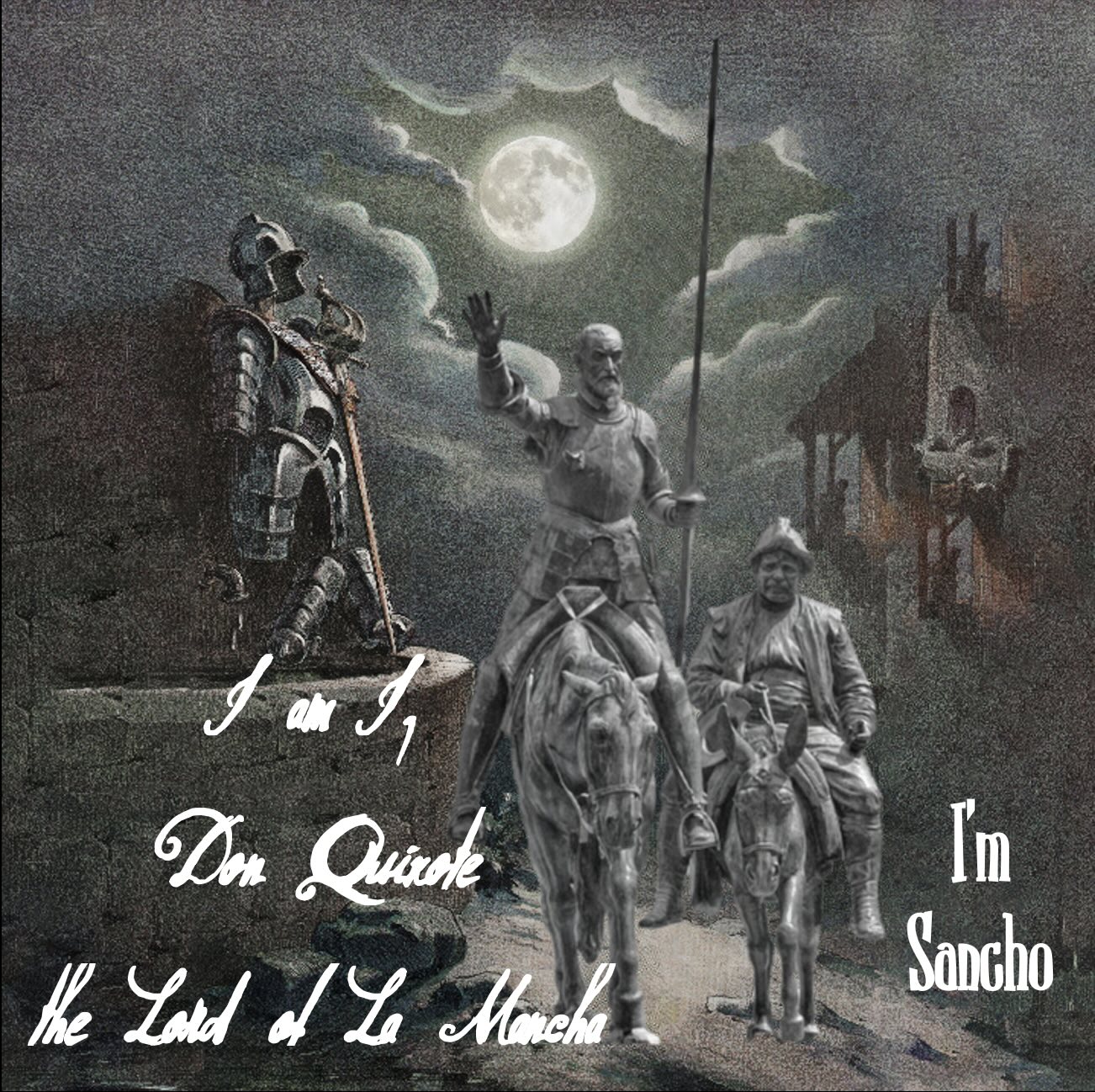
The clearest example I can think of is from the opening number of the musical “Man of La Mancha,” in which Don Quixote and Sancho introduce themselves.
Quixote’s introduction goes “I am I, Don Quixote, the Lord of La Mancha; my destiny calls and I go! And the wild winds of fortune shall carry me onward, how whithersoever they blow.”
Sancho follows with “I’m Sancho! Yes, I’m Sancho! I follow my master ’til the end. I tell all the world proudly, I’m his squire. I’m his friend.”
Those two people do not sound the same at all.
Quixote’s lines use long compound/complex sentences, multi-syllable vocabulary, and alliteration. His verse is longer than Sancho’s, but has only two sentences. One of those sentences has 16 words, the other has 14. Sancho has five sentences. Three of them are three words long or less, and no sentence is longer than seven words. Sancho uses no words that have three or more syllables, and only three two-syllable words other than his own name. All of his sentences are simple and straightforward, and the most complicated they get is a lone prepositional phrase.
That’s how the lyricist made these two people sound different. Shakespeare used a similar technique when he made his noblemen speak mainly in iambic pentameter and his rude mechanicals speak in prose. I did the same for my Faerie Queen in Snow White and Rose Red; it’s a subtle difference in her dialog that sets her apart from all the other characters, without being too obvious. Other writers have used other poetic techniques, like differences in rhythm, slant rhymes, alliteration, etc. to make one character’s speeches read differently from the others.
There are many ways to play with the structure, syntax, and vocabulary of different characters, and they can be combined deliberately to change the voice of different characters and give different impressions. A character who never uses contractions in dialog—who always says “I am,” “I will not,” “You are not,” instead of “I’m,” “I won’t,” and “You aren’t”—may sound a little formal, a little prim, or a little uncomfortable with the English language, depending on what else the writer is doing with that character’s dialog. Keith Laumer’s Retief stories uses carefully scrambled syntax to make it perfectly clear which alien species is speaking. (“To listen with glee to your screams of anguish” could never be said by anyone who wasn’t a Groaci.)
And then there’s the content, which covers everything from cursing to malapropisms to innocuous verbal tics to a tendency to ramble or get distracted by things irrelevant to the current conversation. These can get annoying if one over-uses them, but they can be very useful in dialog from a minor character who needs a really distinct voice for only a few lines.
Finally, there’s trying to render an accent phonetically. I’ve done this a couple of times, but never with a narrator or a central character. Mostly, it’s been characters who drop a “d” or “g” at the end of words (“He’s comin’ back soon.”), and I occasionally regret it. Usually, if I want someone to have a specific regional or language-based accent, I do it with word choice and syntax. (“Me, I do not believe it!” “Are y’all fixing to eat any time soon?”) It’s easier to read and understand than a phonetic respelling, in my opinion.


“Finally, there’s trying to render an accent phonetically. I’ve done this a couple of times, but never with a narrator or a central character. Mostly, it’s been characters who drop a “d” or “g” at the end of words (“He’s comin’ back soon.”), and I occasionally regret it.”
Oh, for sure. Especially if overused. Does this sound like a cowboy?
“Well, I suppose I’ve got to be getting along now.”
It just doesn’t sound quite right. How about this?
“Well, I s’pose I got t’ be gittin’ ‘long now.”
Maybe a little too much? Or how about:
“Waall, Ah’m s’posin’ Ah got t’ be a-gittin’ ‘long ’bout now.”
Yeah, that’s distracting.
And never, o never, use phonetic spellings from a character’s viewpoint. He’s talking normal. You think it sounds funny because of your peculiar accent.
L Sprague de Camp, in his Science Fiction Handbook advised that phonetic spellings be used very sparingly. The example he gave has just one respelling (yust for just) in a paragraph of 100+ words. Everything else is carried by word choice and syntax.
My gloss is that you can (sometimes) get away with one or two frequently repeated words given a consistent respelling, and that a ‘moderate’ amount of phonetic spelling should be taken as signaling an accent thick enough that you need a machete to cut it.
My current protagonist, when provoked, tends to swear. Which would be fine if she’d do it in English, but I’m convinced she swears in Italian, both out loud and in interior dialog. I am getting acquainted with the Wikipedia page about Italian invective. And probably making a lot of mistakes: will want to find someone who actually swears in Italian to look at it eventually. It looks like you can’t just go one-for-one, no surprise.
The protagonist of the previous book stutters a tiny bit (much like my husband). Maybe once or twice a chapter. I think it’d get annoying if it were any more.
Look at the characters in Damon Runyon’s stories (or the musical Guys and Dolls). The lowlifes talk without abbreviations and it sounds slightly affected.
I find it off-putting when characters supposedly speaking their own language talk with an accent — Maurice Chevalier in Gigi?
And it includes all those things in excruciating detail
Yes, indeed. I did a transcription job once, exactly transcribing conversations between parents and small children. If one were to write dialog like that, I doubt a single reader would make it past the first page.