Graphic by Peg Ihinger
Passage of time in a story can be a tricky thing, and the longer the story is and the more of the characters’ lives it covers, the trickier (and more necessary) it can be. The more story-time a work covers, the larger the chance it that some of what the character does is not going to be significant to the story one is telling. Nobody needs to watch thirty years’ worth of the protagonist eating breakfast and doing laundry.
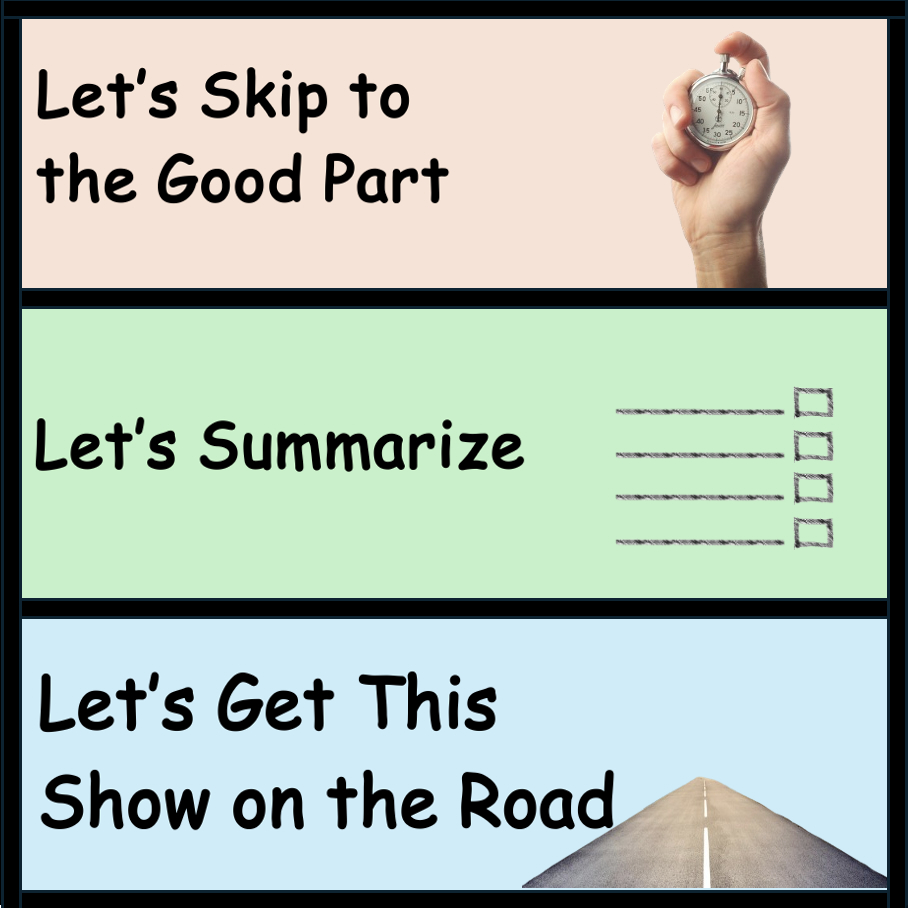
There are three basic methods of covering ground in a story.
1) The writer can skip events entirely. Events that are obvious, repetitive, and/or completely irrelevant to the story can simply be skipped entirely. The reader doesn’t need to watch the protagonist exchange polite small talk with the grocery store clerk if nothing else happens. Readers also don’t need to watch the character get up, dress, and make breakfast every single day. (Days when breakfast is interrupted by surprise ninjas are unusual enough to warrant an exception, because even if surprise ninjas are a routine occurrence in the character’s household, they are highly unlikely to be a common part of the readers’ daily lives.)
Skipping short amounts of time in the middle of a chapter often (but not always) gets done with a jump-cut (a blank line inserted between the end of one scene (“I’ll think about it,” he said, and left) and the opening of the next scene (The following Thursday, he arrived at the farrier’s early.) Skipping time between chapters has a similar effect, but is more flexible—the next chapter can start immediately after the previous one (no time skipped), a short time later (hours or days), or a long time later (months or years).
(Note that space breaks are also used to show that the viewpoint character has changed, so if you’re writing a multiple-viewpoint novel, it’s better not to use space-breaks to indicate skipping time. Most multiple-viewpoint works don’t need this warning, because one of the other viewpoint characters is usually doing something interesting during the time the first character is sleeping, traveling, in the boring meeting, or whatever.)
Both the chapter end and the jump-cut provide a visual break that lets readers know time is passing. Since neither method tells the reader how much time has passed, the opening of the next scene has to provide that information (“Next morning, he…” “When the day of the party arrived, the household…” “Two weeks later, he was…”) Short, obvious skips like commuting or having breakfast usually need to mention the lapse in time, but don’t necessarily require a jump-cut at all. (He left. By the time he reached home, he had decided…)
2) The writer can summarize events. This method is frequently used as a transition between one story-relevant event and the next one. Sometimes, a single sentence is all that’s needed (“With that, he left. He drove home in a thoughtful mood, and pondered the information all evening. The next morning, bright and early, he presented himself at the marshall’s office.”) Longer periods may need a couple of paragraphs covering key events, usually weeks, months, or, in some cases, years. (The need to cover that much time isn’t exclusive to novels. Guy de Maupassant’s short story “The Necklace” spends two paragraphs summarizing the hardships of the next twenty years of the protagonists coping.)
Summarizing can also be used to cover things the writer wants the reader to know, but doesn’t want to cover in detail because doing so would be repetitive, tedious, irrelevant, or boring. “He spent three weeks going through the first two rooms of the Library of Alexandria, before discovering the right manual in the third room under a pile of recipes.” “She wasted the entire evening on a pointless blind date.” “Now that they had the key ingredient, building the force field was a simple matter of three weeks of grinding work.”
Summarizing is also a useful choice when the writer wants to keep the focus on the main plot and/or pick up the pace. “The trip to Evercloud took a routine three weeks, and her business there took two. Coming back took far longer. First a landslide required the caravan to backtrack and take a longer route; then two wagons broke an axle on the rougher ground, which lost them another week. Fighting off the first bandit attach was less a delay than a warning of the need for more guards. Hiring guards in the middle of a route, however, took time, and stocking additional supplies to feed the guards and their horses took even more. By the time she finally returned home, the deadline was only two days away.” In this case, the events of the return trip sound as if they’d be interesting to watch, but the writer decided not to show them in detail because they’d distract from (and slow down) the progression of the main plot.
Finally, summarizing acts as a signal that the events in question are unimportant to the main plot (like the disasters that slow the caravan down in the above summary).
3) The writer can show the events at some level of detail. The writer does a fully developed scene, including narrative, action, dialog, and interior monologue as needed. (A scene in which the viewpoint character is breaking into a house alone is obviously not going to need any dialog, for instance.) I’m assuming here that most people here already know how a full scene is different from skipping or summarizing, so I’m not going into more detail about it here.
The choice of whether to skip, summarize, or show depends partly on the writer’s style and voice, partly on the story being told, and partly on exactly what the writer wants or needs to accomplish at this point in the story. For instance, the writer might choose to show the protagonist having breakfast or commuting early in a story in order to do some worldbuilding or develop the character, but skip those bits later in the manuscript.


Leave a Reply