Graphic by Peg Ihinger
“The truest thing you can say about writing is ‘it depends'”—Scott Lynch
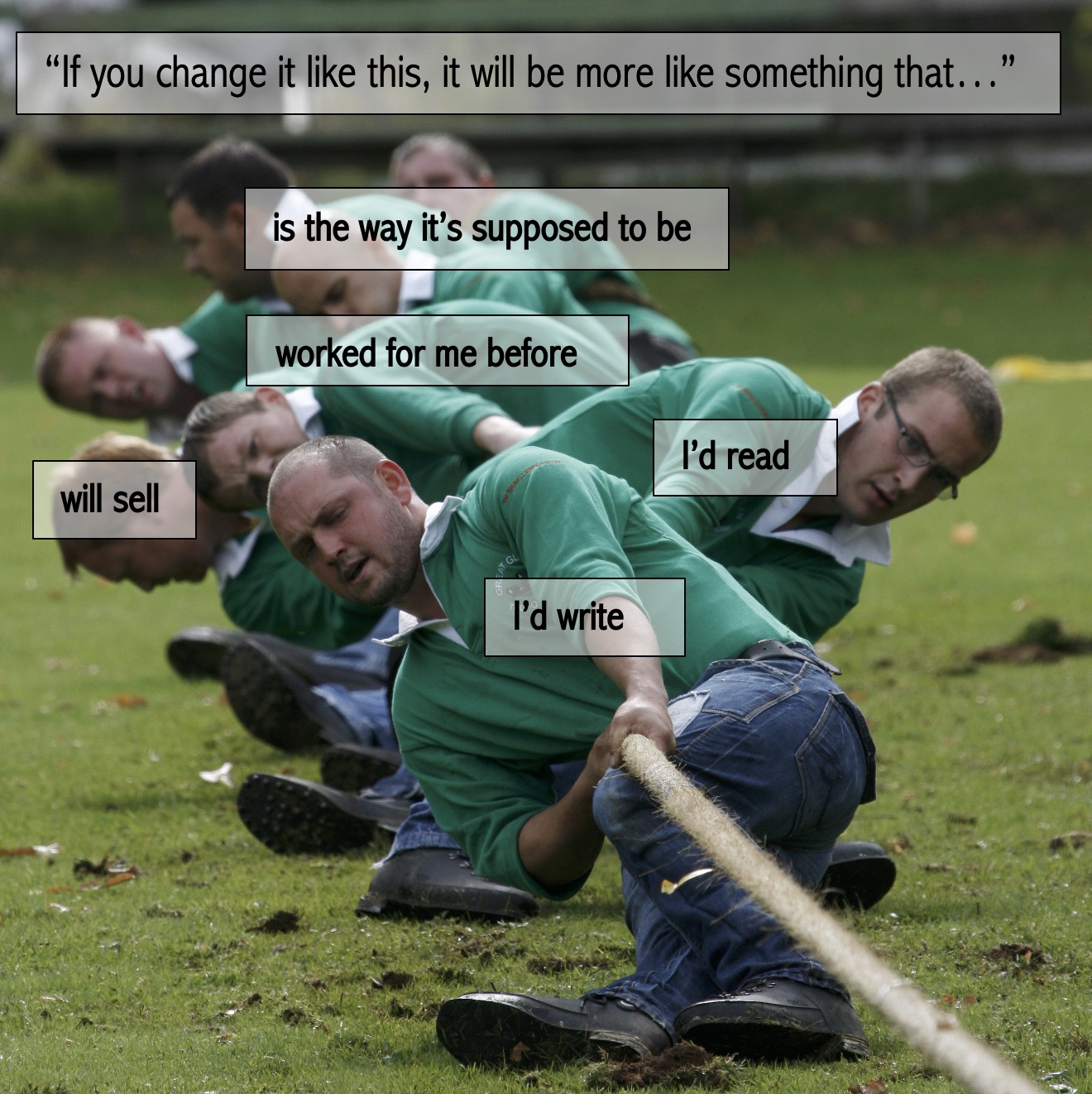
“It depends” is the experienced writer’s answer to anyone who’s looking for rules and recipes. There is no “right answer.” There is only “a possible right answer for this story.” Even then, it’s only a possible right answer. There are always other possibilities.
Some of those possibilities will significantly change the story. Some won’t. Those changes will not be “better,” nor will they be “worse.” They will make the story different. The new story may suit the writer’s current skills down to the ground, or it may challenge the writer to develop new skills that will enrich everything they write going forward.
The one thing that I have learned about this process is to never, ever make fundamental story changes simply because someone else claims that’s how the story should be written. If I do not see the problem myself, and agree that it is a problem, I don’t fix it.
This does not apply to things that are independently verifiable, like spelling, or whether there should or should not be a comma (or semicolon, or single quotes) in a particular place (I just got done with the copy-edit for How to Rule Your Evil Empire, formerly titled Dark Lady, and there were a LOT of comma problems. Apparently, the rules have changed in the past fifty years…). And even spelling, punctuation, and grammar are sometimes arguable, if the “error” is there on purpose, to achieve a specific effect.
What I class as “fundamental story changes” range from relatively minor things (cutting a scene, adding a scene, moving a scene) to major surgery (changing the viewpoint, changing the protagonist, inserting or removing entire subplots, backing up and completely changing three or more chapters so that the plot goes in a new direction, changing the structure). All of them have a ripple effect that means they take more thought than you’d think at first glance, and often require something to be done in more than one place to keep things consistent.
I have done every one of those things to a work-in-process, and sometimes I have done them at the behest of my crit group, beta readers, or editor. A couple of times, I have tried to do something, simply because someone whose judgment I trusted made a convincing case for doing it…but those attempts haven’t ever made it into the final draft of the story. Because attempting to “fix a problem” that I can’t see is like trying to repair a delicate piece of machinery blindfolded and wearing oven mitts. I just can’t get it to work.
People who recommend fundamental story changes do so for a bunch of reasons. Among them are:
- The change makes my story more like the story they would want to write.
- The change makes it more like the sort of stories they know they like to read.
- The change is something that has worked for them at least once.
- They think the change will make the story more likely to sell. (I have never once gotten this kind of advice from a writer who has actual experience with the market.)
- The person read somewhere that all stories have to work this way, and they believe it.
- The reader is suggesting the change because they missed or misinterpreted something in the story that would make any change unnecessary, or because they’ve made wildly incorrect assumptions about where the story is going.
- The read has seen a fundamental problem that needs fixing.
- The reader has seen a fundamental problem that the writer cannot see.
I try to be polite about the first five, as long as the advisor isn’t too pushy about their opinions. I also try to consider the first five seriously for at least a few minutes, because sometimes people actually have spotted a problem but they are simply phrasing it in terms that sound like one of these. Also, I have two excellent beta readers who cannot seem to verbalize what they think a problem is; they can only explain what they think I should do to fix it (which is a) never the way I would fix it and b) nearly always sounds like one of the first five things). So I have had to learn to translate in those specific cases.
But the things I actually worry about are the last three points on the list.
#6 is relatively simple, because when someone has obviously missed something that didn’t get onto the page strongly enough, the solution is to punch up the facts they missed. The solution for #7 is also obvious, though not always straightforward. Once someone has pointed out that the tension flags in the middle or that there’s a serious contradiction in the protagonist’s motivation, I can see it. Figuring out how to fix that and where to put the fixes is often difficult and annoying, but it has to be done.
The real problem is #8. Because when beta-readers see problems I can’t, they can often make a really good case for their position. In the very rare best case, I eventually do see the problem, but it’s always very tough to fix, because it started out as a blind spot, which means I haven’t ever tried to fix it before. Most of the time, I don’t try to fix something I can’t see, and it gets published that way. Five or ten years later, when I look at the book, I go “Oh, that’s what they meant,” because in the interim I’ve somehow learned to see it.
What I do not do is agonize over whether I should have taken so-and-so’s advice five years ago. The thing is out; I’m not revising it now. And I don’t really regret not taking the advice, because by the time I can see the issue, I can also see all the things I could have (and probably would have) messed up by trying to fix it when I didn’t know what I was doing. Perfection is not a realistic goal. Growth is.


Great post, as always.
“…there were a LOT of comma problems. Apparently, the rules have changed in the past fifty years…”
I ran into this when I was the “style and usage” guy in my nonfiction days. Punctuation on the whole is on the wane. The things we used to set off with commas we mostly don’t anymore. (Because we want our writing to sound comparatively breathless? I dunno.)
As far as “it depends,” of course I agree. But I dearly love edge cases to make a point with – because with hardheads who’ve been assigned to write something up but don’t want to, you need heavy hitters to convince them with.
Anyway, I’ve come up with three hard-and-fast “don’t ever do this” rules:
1. Don’t write a 500-page novel, encode it, and then expect readers to do the decoding. Especially if they don’t have the key. (Possible exception: You’ve buried this million-dollar treasure…)
– Corollary: That 500-page sequel to Beowulf might not be that marketable since you wrote it in Old English.
2. Don’t leave every single sentence unfin
3. I once remarked to my brother that I needed a couple thousand more words to get to novella length, and his instant suggestion had me rolling on the floor:
“He walked and walked and walked and walked and walked and walked and walked and walked and walked and walked and walked and walked and walked and walked and …”
🙂
Things the author did not see (or the editor or the publishers):
In the first edition of Ringworld, Larry Niven essentially had the Earth rotating backward.
Re #5, there was one fellow in our writing group who had read Algis Budrys’ guidelines for structuring a story and decided that any story that did not follow that format was a failure, regardless of whatever else it might have going for it.
I have a small collection of (other peoples’) weird short stories to trot out when someone gets too formulaic about what a story must be. I love “comp.basilisk FAQ” by Langford, which has no characters, arguably no plot either. Just setting, and the setting is depicted in a very oblique way.
Another favorite is “Three Versions of Judas” by Borges, which is a counterfactual scholarly essay. This one has characters, but next to no plot or setting (it’s not clear to me if it’s a counterfactual in our world, or in a similar alternate world).
“Mitosis” by Calvino is a pretty scientifically accurate description of cell division, but from a first-person point of view. It’s got a character, and a plot of sorts (“cell divides”)….
At novel length there’s Crowley’s _Little, Big_ which is organized something like A-B-C-C-B-A rather than any normal plot or chronology.
Little Big is one of those too-rare books that gets better with each reading.
I had fun with Queen Shulamith’s Ball, where my rule was no scene breaks. There is some summary, but it handles people sleeping or otherwise ceasing to be storying by shifting viewpoint. Relentlessly. Over days.
It can be so interesting juggling writing advice.
But why do you write advice in a blog?
Lots of reasons. I enjoy talking about writing. Writing this blog helps me articulate what I’ve learned. I’m paying forward what some established professional writers did for me, back when I was an unpublished beginner. I learn new things by doing this. I’m a writer; I have weird hobbies.
I must say that I do not express nearly as much as I should how greatly I appreciate this blog – which gives some of the best advice and clarifications on the writing process I have seen anywhere.
I second the appreciation!!
Thank you both very much.
Also seconding (thirding?). The advice here is generally outstanding, even for someone like me who doesn’t often click with writing advice. Plus, sometimes it’s just nice to know that other people are struggling with the same recalcitrant word-tangles.
One thing that interest people in my stories is that I turn upeiden down their expectations. They wait something because of traditions and they get something Else.